#CO2 #Biogas #Industrialbiogas #Sustainability #Carbonimpact
Industrial Biogas: Why Carbon Outcomes Differ from Municipal Systems
Industrial biogas is often discussed in the same breath as sustainability, renewable energy, and carbon reduction; yet in practice, the carbon outcomes it delivers vary far more than most narratives acknowledge.
Two biogas systems may rely on similar digestion technology and comparable feedstocks, but the climate impact they create can be fundamentally different. The explanation does not lie in the biology of anaerobic digestion. It lies in what follows once the gas is generated.
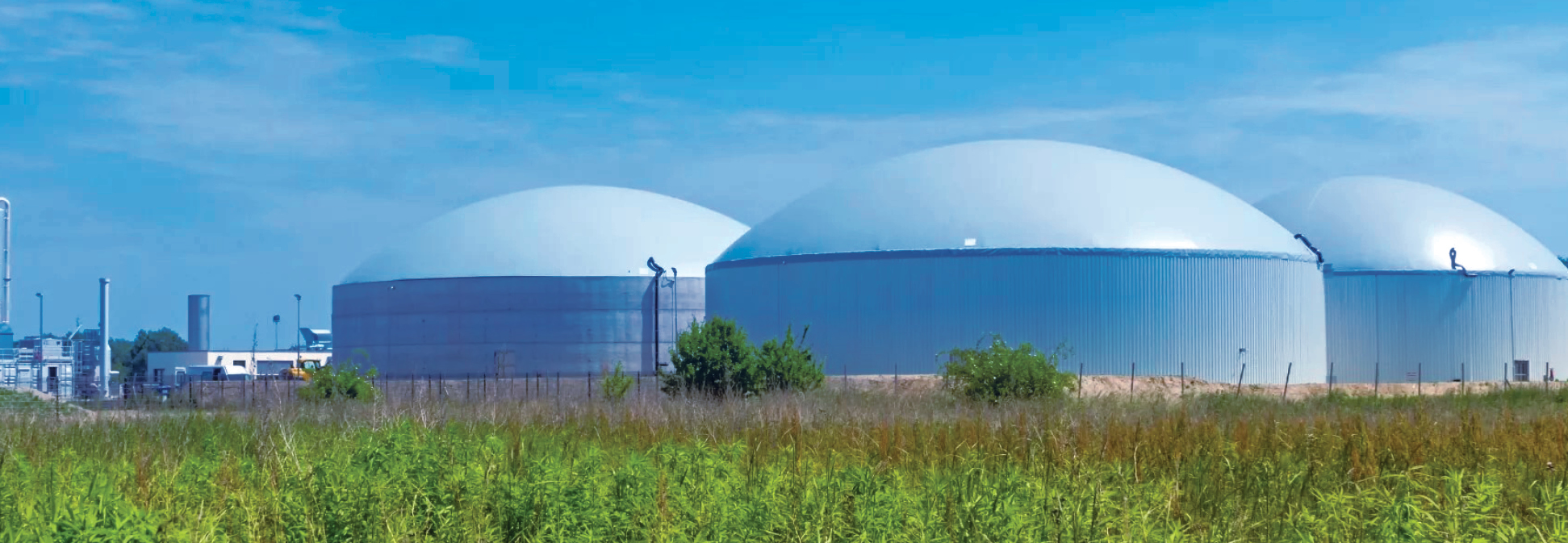
In many projects, sustainability claims end with methane capture or electricity generation. From a carbon perspective, that is only the starting point. Once biogas exits the digester, decisions around gas handling, utilisation pathways, and emissions control begin to shape the real outcome.
Whether the gas is combusted efficiently, partially vented, diluted into exhaust streams, or treated as a managed process flow directly determines how much carbon is actually reduced; and how much is merely displaced.
This is where outcomes start to diverge. Some biogas systems are designed to integrate tightly with industrial processes, where energy substitution, fuel efficiency, and emissions accountability are non-negotiable.
Others operate with a narrower objective, delivering renewable energy without full control over downstream carbon behaviour. The difference is subtle at the design stage, but significant in long-term performance.
Audits and emissions data increasingly reflect this gap. Plants with similar biogas capacity can show markedly different Scope 1 results, not because one produces more gas, but because one manages carbon intentionally while the other does not.
Losses through venting, flaring, or underutilization rarely appear in headline sustainability claims, yet they materially affect the final carbon balance.
Understanding why these differences exist requires looking beyond biogas generation itself and examining the intent built into the system. That intent becomes clear when municipal and industrial biogas models are viewed side by side; where similar inputs lead to very different carbon outcomes by design, not by chance.
Municipal vs Industrial Biogas; A Difference of Intent
At a surface level, municipal and industrial biogas systems appear similar. Both rely on anaerobic digestion. Both generate methane-rich gas. Both are often grouped under the same sustainability umbrella. The similarity ends there.
Municipal biogas is designed first and foremost as a waste-management solution. Its primary role is public service: stabilising organic waste, reducing landfill burden, and managing environmental risk.
Energy generation, when it occurs, is typically a secondary outcome; useful, but not mission-critical. Success is measured in tonnes of waste treated, odor control, regulatory compliance, and megawatt-hours exported to the grid.
Industrial biogas is built with a very different intent. Here, biogas is not a by-product of waste treatment; it is a process input.
The system is designed to integrate with plant operations, displace fossil fuels, stabilise energy supply, and reduce operating emissions. Performance is judged on fuel substitution efficiency, reliability, and how effectively carbon is controlled within the production boundary.
This difference in intent shapes every downstream decision. Municipal systems can tolerate variability because the core objective is waste stabilisation. Industrial systems cannot.
Variations in gas composition, pressure, or availability directly affect process efficiency, energy economics, and emissions reporting. As a result, industrial biogas demands tighter operational discipline; even when the digestion technology itself is similar.
CO2 becomes relevant only at this point. In municipal setups, it is largely incidental; present, but unmanaged. In industrial environments, CO2 enters the equation because utilization intent exists. Once biogas is treated as a fuel or process stream rather than an environmental outcome, its full composition begins to matter.
That distinction explains why municipal and industrial biogas, despite shared origins, deliver fundamentally different carbon results. And it is why the next divider is not policy or scale but gas quality itself.
Gas Quality; The Hidden Divider
Gas quality is where the difference between municipal and industrial biogas becomes operationally visible. Not in theory. On the plant floor. Municipal biogas systems typically deal with high feedstock variability; seasonal organic waste, mixed inputs, and fluctuating digestion conditions.
As a result, gas composition shifts frequently. Methane concentration swings. Moisture levels rise and fall. Trace contaminants appear unpredictably. For systems designed primarily around waste stabilisation, this variability is tolerated.
Industrial biogas does not have that luxury.
In industrial environments, biogas is expected to behave like a process fuel, not an environmental by-product. Boilers, thermal systems, and CHP units demand consistency. Even small deviations in composition affect combustion efficiency, heat balance, and emissions stability.
Over time, inconsistent gas quality leads to conservative operating choices; often at the cost of carbon performance.
Real-world examples illustrate this clearly.
In Germany, several municipal wastewater treatment plants producing biogas for CHP have publicly documented derating of engines during periods of feedstock fluctuation, forcing partial flaring to protect equipment. These findings are routinely referenced in performance reviews published by regional utility associations.
In Denmark, industrial food-processing facilities integrating biogas into thermal systems report far tighter gas-conditioning requirements, driven by internal energy audits and ISO 50001 compliance frameworks. Here, variability is treated as a system failure, not an operational inconvenience.
When gas quality cannot be stabilised, the consequences are predictable:
- Flaring becomes a risk-control mechanism
- Combustion systems operate below optimal efficiency
- Downstream carbon opportunities remain inaccessible
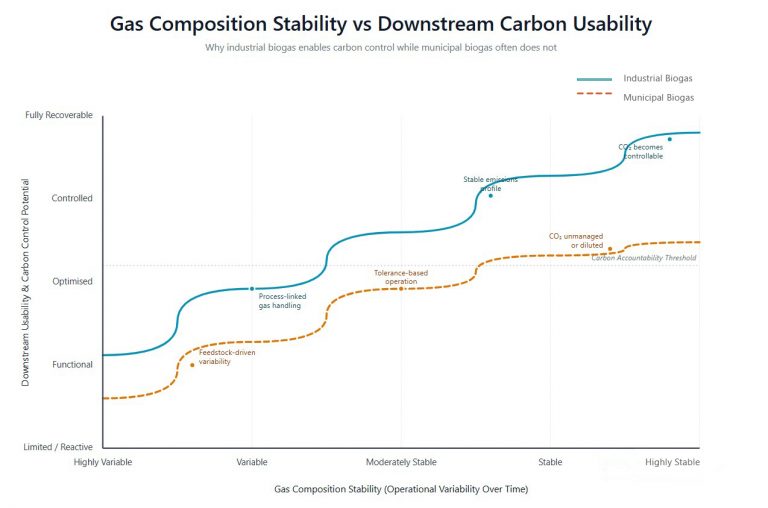
Once gas quality is treated as a controllable variable rather than a tolerated uncertainty, the system crosses an important threshold. Utilisation choices expand. Carbon losses reduce. And sustainability moves from assumed to engineered.
That shift is what determines whether biogas remains an energy offset or becomes a carbon-controlled system.
How Industrial Biogas Utilisation Shapes Sustainability
Once gas quality reaches a level of operational stability, the next variable that defines carbon performance is how biogas is used. This is where industrial biogas and municipal biogas begin to diverge decisively; not because of technology, but because of utilization intent.
In municipal biogas systems, utilisation is often shaped by grid connectivity and public-energy objectives. Power export becomes the default pathway, and carbon benefit is framed as displacement rather than control.
The emissions impact exists, but it sits outside the plant boundary and is largely influenced by grid factors beyond operator control.
Industrial biogas follows a different logic. Here, utilisation is a design decision tied directly to process economics. Biogas is expected to replace purchased fuels, stabilise thermal demand, and perform consistently under production conditions.
As a result, carbon reduction becomes internal, measurable, and accountable; particularly where biogas displaces fossil thermal energy rather than being exported as electricity.
The distinction becomes clearer when common utilisation pathways are viewed side by side.
| Utilisation Pathway | Where It Is Commonly Used | Primary Decision Driver | How Carbon Reduction Is Realised | Scope 1 Accountability | Typical Limitation |
|---|---|---|---|---|---|
|
Power Export |
Municipal biogas plants, grid-connected digesters |
Energy monetisation, grid compliance |
Emissions are displaced to the grid mix |
Low |
Carbon benefit depends on grid factors, not plant control |
|
CHP (Power + Heat) |
Mixed municipal–industrial setups |
Electrical efficiency, asset utilisation |
Partial fuel displacement with shared benefits |
Medium |
Electrical optimisation often overrides carbon optimisation |
|
Direct Thermal Use |
Industrial biogas systems |
Fossil fuel replacement, process stability |
One-to-one substitution of fossil thermal energy |
High |
Requires stable gas quality and predictable demand |
|
Process-Integrated Fuel Use |
Continuous industrial operations |
Operational reliability, emissions control |
Carbon reduction embedded directly into production |
Very High |
Demands tight gas handling discipline |
|
Export-Oriented Use with Limited Internal Demand |
Sites with surplus gas |
Asset optimisation |
Avoided emissions claimed indirectly |
Low to Medium |
Carbon outcomes weaken when utilisation is disconnected |
What this comparison reveals is not a hierarchy of technologies, but a difference in carbon ownership. In power-export-heavy models, carbon benefits are assumed and externalised. In process-integrated industrial biogas systems, carbon reduction is engineered into day-to-day operations and reflected directly in Scope 1 performance.
This distinction explains why some biogas projects report sustainability through avoided emissions, while others are forced to account for every tonne within their boundary. Only the latter creates the conditions where carbon management becomes a necessity rather than an aspiration.
And it is at this point; when utilisation is internal, intentional, and accountable; that the question of what to do with CO2 can no longer be deferred.
CO2 — Vent, Recover, or Waste?
CO2 in biogas systems is not inherently a problem. It becomes a problem only when it is left unmanaged.
Once gas quality is stable and utilisation is internal, operators face three clear choices; each carrying very different carbon consequences:
- Vent it
- Waste it indirectly through dilution
- Recover it as a controlled carbon stream
Only one of these choices aligns with accountable sustainability.
Venting is not neutral
Venting remains common in municipal biogas and export-heavy configurations. CO2 is treated as unavoidable ballast; present, acknowledged, and released. Emissions are accepted rather than questioned, and the carbon impact is externalized beyond the plant boundary. This is not a failure of intent, but a consequence of systems designed around energy disposal rather than carbon control.
Dilution disguises loss; it doesn’t remove it
This is where many otherwise efficient plants plateau.
- Stable gas quality
- Predictable utilisation
- Internal emissions accountability
This is where Hypro becomes relevant; as an engineering solution applied in systems where carbon management is treated as an operational responsibility, not an afterthought.
A clear illustration can be seen in the neustark projects in Switzerland and France, where municipal waste is converted into biogas through established digestion systems. Hypro supported these projects through its CO2 evaporator, enabling reliable handling of liquid CO2 for downstream use.
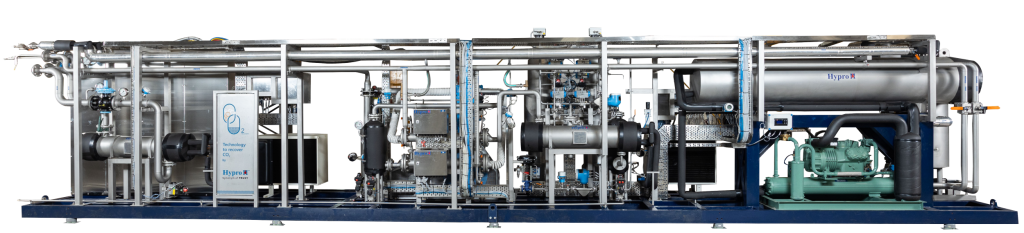
At the same time, Hypro designs and delivers complete CO2 recovery plants for industrial and municipal biogas systems where recovery, reuse, or compliance-driven outcomes are required.
For systems engineered with intent; industrial or municipal; this is the turning point. CO2 stops being absorbed as loss and starts being addressed as process reality. From that moment on, the system has no choice but to operate to a higher standard.
Why Industrial Biogas Demands Higher Gas Integrity
Industrial biogas systems operate under tighter constraints because downstream outcomes depend on predictability, not averages. Variability can be tolerated at the digester. It cannot be tolerated beyond it.
Stable composition enables purification.
Purification processes are designed to operate within narrow windows. When methane concentration, moisture, or trace components fluctuate, systems are forced into bypass, derating, or intermittent operation. In industrial biogas, such variability is treated as a design failure, not an operating condition, because it directly undermines reliability and emissions performance.
Purity defines reuse, recovery, and compliance.
CO2 recovery is viable only when gas handling is intentional.
Recovery works when gas handling is planned from the outset; aligned with utilisation, controls, and accountability. Retrofitted or tolerance-based systems struggle because recovery tolerates no instability. Industrial biogas systems, by intent, are built around internal performance obligations. That intent makes higher gas integrity unavoidable; and makes recovery structurally viable.
When integrity is engineered, carbon outcomes become measurable. When it is not, sustainability remains theoretical.
The Sustainability Gap Between Theory and Reality
Two biogas plants can be commissioned in the same year, built to similar capacity, and fed with comparable organic waste; yet within a short period, their carbon performance can diverge sharply. On paper, both look “sustainable.” In operation, only one may actually behave that way.
The gap rarely comes from technology choice. It emerges quietly in day-to-day operation; through what is lost, what is released, and what is never fully used.
Where the gap actually forms
| What the plant is designed for | What often happens in reality | Carbon consequence |
|---|---|---|
|
Rated biogas output |
Incremental gas losses during handling and compression |
Emissions accumulate unnoticed over time |
|
Continuous utilisation |
Venting during start-ups, upsets, or load changes |
Direct CO2 release becomes routine |
|
Full gas consumption |
Mismatch between gas availability and process |
Recoverable carbon remains unused |
|
“Sustainable” performance |
Operational compromises normalised over time |
Carbon results fall short of claims |
Dilution disguises loss; it doesn’t remove it
None of these issues appear dramatic in isolation. Together, they define why two plants with similar capacity can deliver very different carbon outcomes.
This is why sustainability cannot be inferred from design intent or installed capacity alone. It is revealed only in how the system actually performs; day after day, under real operating conditions.
Designing for Carbon Confidence, Not Just Biogas Generation
Municipal and industrial biogas both play an important role in the energy transition. But their sustainability outcomes are shaped less by digestion itself and more by what the system is designed to do beyond it.
Biogas generation addresses waste and energy. Credible sustainability begins only when gas handling, utilisation, and emissions are treated as integrated system responsibilities. That is where intent becomes measurable, losses are questioned, and carbon outcomes can be verified.
CO2 recovery closes this loop; not as an add-on, but as the natural consequence of systems built with clarity around utilisation, purity, and accountability. When those elements align, biogas moves from being a renewable input to a controlled carbon strategy.
That distinction is what separates sustainability claims from carbon confidence.
Related Posts
Advanced CO2 recovery technology for Biogas efficiency.
At Hypro, we have pioneered a cutting-edge solution for CO2 recovery from biogas, ensuring that this by-product is not wasted but instead repurposed for various...
Read More
Biogas vs Green Hydrogen: Companions or Competitors in the Clean Energy Revolution?
Biogas and green hydrogen are two promising renewable energy sources, each with unique advantages and challenges. This blog dives into their efficiency, sustainability, and role...
Read More
Engineering Sustainability: Every Day is Earth Day at Hypro
Hypro believes Earth Day is more than a moment - it’s a mission. From sustainability-driven innovations to CO2 recovery and digital transformation, discover how Hypro...
Read More
Environment first: A resilient circular carbon journey led by Hypro
On the World Environment Day, Hypro redefines the role of industry - not as a force that extracts, but as one that restores. With over...
Read More