#beer #wine #CO2 #Fermentation #carbonemissions
Beer and Wine Sustainability Showdown
How Packaging and Transportation Emissions Drive the Footprint
packaging and transportation emissions
In recent life-cycle assessments, packaging and transportation emissions emerge as the largest contributors to the total carbon footprint of beer and wine, often exceeding production-related emissions.

Beer, however, introduces another variable. According to the Brewers Association’s 2023 sustainability benchmarking, cold-chain dependence often surpasses packaging as a downstream emission source, especially for products requiring temperature-controlled transport or extended refrigerated storage. Even with lightweight packaging, chilled logistics markedly elevate the overall impact.
Taken together, the data reinforces a structural truth: downstream decisions around material choice, weight, logistics pathways, and handling conditions now shape much of the sustainability profile of beer and wine — long after fermentation is complete.
Packaging Choices: Glass, Aluminum, or Barrel
Packaging is no longer a design preference; it is an emissions architecture. For both beer and wine, packaging determines how much carbon is locked into the product before it moves through logistics. Material intensity, weight, recyclability, and protection requirements together shape most downstream impact — and explain why categories diverge so sharply in their ability to lower packaging and transportation emissions.
To evaluate packaging meaningfully, it is more useful to analyse the pressure points that actually drive emissions rather than the formats themselves.
Pressure Point 1: Embodied Carbon (Material Production)
The energy required to produce packaging materials varies dramatically.
Aluminum cans with 70–90% recycled content reduce manufacturing emissions by 30–40% compared to virgin aluminum, making them one of beer’s most efficient formats. Glass remains the most energy-intensive material in both categories, driven by furnace temperatures exceeding 1,500°C. Lightweighting reduces this burden — cutting emissions per wine bottle by up to 30% — but standard single-use glass still anchors wine’s downstream footprint.
Pressure Point 2: Transport Weight & Pallet Density
Here, beer and wine split decisively. Heavy single-use wine bottles dominate the total footprint because freight emissions scale directly with weight. This is why bag-in-box formats reduce packaging footprint by 70–80% and improve palletisation efficiency, outperforming all other wine formats for everyday consumption tiers.
Beer has more structural flexibility. Cans deliver superior pallet density. Kegs, when used within closed-loop regional systems, distribute embodied carbon across many cycles and offer the best mass-efficiency profile of any beer format. These weight dynamics explain why packaging decisions effectively predetermine transport emissions.
Pressure Point 3: Product Protection Requirements
Not all packaging formats are interchangeable. Beer’s sensitivity to light, oxidation, and thermal variation makes material choice tightly linked to product stability. Ambient-stable beers can move into cans or lightweight bottles without compromising integrity, whereas sensitive styles require more controlled conditions.
Wine introduces non-negotiables: oxygen transmission rates, UV protection, and ageing expectations restrict how far premium segments can move from glass. The shift toward alternative formats — such as paper/fibre bottles — remains limited to wines that do not require long-term stability.
Pressure Point 4: End-of-Life Performance & System Compatibility
Recycling effectiveness shapes the life-cycle impact of each format. Aluminum retains superior circularity, with high global recovery rates and minimal degradation across cycles. Glass presents a more complex picture: while theoretically infinitely recyclable, contamination and collection gaps limit real-world recovery. Refillable glass is highly efficient where infrastructure exists, but adoption remains uneven. Kegs and growlers outperform almost all other formats in circular systems, provided return compliance remains high.
Packaging Selection Matrix
A practical decision matrix for producers evaluating packaging choices.
| Condition | Recommended Format |
|---|---|
|
Long freight distance; low premium positioning |
Bag-in-box or lightweight PET/fibre bottle |
|
High recycled-content supply; need for logistics efficiency |
Aluminum cans |
|
Regional distribution with strong return systems |
Refillable glass or stainless-steel kegs |
|
Ageing potential or premium perception required |
Single-use or lightweight glass |
|
Cold-chain dependency is low; stability is high |
Lightweight glass or cans |
|
On-premise, high-turnover environments |
Kegs or growlers |
Category-Level Reality Check
Beer continues to innovate faster because it operates across multiple viable packaging ecosystems — cans, kegs, lightweight bottles, returnables. Wine’s reliance on single-use glass restricts the pace of change, concentrating innovation in lightweighting and alternative formats for market segments where ageing and brand cues matter less.
Once packaging architecture is set, the next determinant of lifecycle performance is how effectively the product moves — chilled or ambient, local or export-heavy — through the supply chain.
Transportation & Storage
Transportation and storage shape a large share of the downstream footprint for beer and wine, but the drivers are structurally different across the two categories. Weight, temperature-control requirements, and distribution architecture determine the carbon intensity of every kilometre moved — often more than production variables upstream. These differences explain why logistics innovation behaves unevenly across the sector.
How Packaging and Transportation Emissions Interact Across Beer and Wine
A. Weight-to-Carbon Ratio: Why Freight Punishes Wine More Than Beer
Freight emissions scale with mass, and single-use wine bottles carry one of the highest weight penalties in the beverage industry. A standard 750 ml glass bottle often weighs more than the product it contains, and pallet density decreases accordingly. For long-haul shipments — common in export markets such as the UK, US, and East Asia — this weight becomes the dominant contributor to downstream emissions.
Beer, by comparison, uses far lighter containers across most SKUs. Cans allow higher pallet density and lower weight per unit, reducing freight emissions by design. Even when beer moves in glass, packaging diversity (lightweight bottles, kegs, cans) enables breweries to optimise for route-specific efficiency — an option unavailable to most wineries.
B. Chilled vs Ambient Logistics: The Most Critical Divergence Point
Winemaking relies less on thermal extremes, but more on time-controlled environments.Beer’s downstream footprint is shaped less by distance and more by temperature control. Premium and unpasteurised styles often require a cold chain from brewery to distributor to retail.
Refrigerated transport consumes significantly more energy than ambient freight, and storage at distribution centres amplifies this load. Logistics studies in North America and Europe show that poorly optimised cold chains can raise total downstream emissions for certain beer SKUs by 20–30%, regardless of transport distance.
Wine rarely requires refrigeration during transport. Ambient shipping stabilises its energy profile, making weight — not temperature — the primary lever. However, once wine enters long-distance export channels, freight mode selection (road, rail, sea) becomes the main variable influencing emissions.
C. Supply Chain Geography: Local Consumption vs Global Distribution
Beer is largely a regional product. Most breweries serve defined distribution radii, allowing route optimisation, keg return cycles, and reduced handling. This concentrated geography limits the exposure to long-haul logistics and enables investments in efficient cold-chain systems.
Wine is structurally global. Producers in Europe, South America, Australia, South Africa, and North America export considerable volumes, often over intercontinental distances. Long-haul sea freight followed by road distribution contributes meaningfully to total lifecycle emissions. For many wineries, transport generates a larger share of downstream footprint than fermentation or vineyard operations.
This geographic asymmetry is why lightweight bottles and bulk shipping — where wine is transported in flexitanks and bottled locally — have such transformative potential.
D. Storage Dynamics: Retail and Distribution Behaviour
Beer faces additional downstream load from extended cold storage in retail environments. Display refrigeration is energy-intensive, and poorly managed temperature cycles compound losses. Stability-optimised SKUs help reduce this burden, but consumer expectations for cold beer sustain demand for chilled retail conditions.
Wine’s storage emissions are comparatively low. Most retail environments keep wine at ambient temperature, and warehouse conditions rarely require active cooling except for premium cellaring. The main storage-related emissions in wine arise from secondary packaging and pallet handling rather than temperature control.
E. Strategic Insight: Logistics Reinforces Packaging Constraints
Transport and storage don’t operate independently; they amplify packaging decisions. Heavy glass raises freight emissions. Temperature-sensitive beer raises cold-chain emissions. Lightweight or high-density formats improve logistics efficiency instantly, while ambient-stable products reduce the need for chilled distribution.
This interplay is why logistics innovation — route optimisation, freight-mode shifting, bulk shipping, and cold-chain rationalisation — works best when upstream packaging architecture has already been optimised.
Waste & Recycling
Waste systems reveal the real performance of packaging formats, and beer and wine behave very differently once they enter the post-consumer stream. Global recycling data makes the contrast clear.
A. Recovery Rates Define the Real Footprint
Across mature recycling markets, aluminum consistently achieves 65–75% real recovery, driven by strong commodity value and efficient sorting. Glass performs far lower: although technically recyclable, effective furnace-ready recovery often sits between 30–40%, with higher losses for coloured or contaminated streams. Composite and carton formats remain region-dependent, achieving 20–30% recovery only where specialised processing exists.
B. Beer Performs Better in Current Waste Systems
Beer aligns more naturally with existing waste infrastructure.
- Aluminum cans cycle effectively through established scrap systems.
- Kegs eliminate single-use waste entirely.
- Refillable beer bottles reach high return rates (70–90%) in regions with deposit-return schemes.
The outcome is a relatively efficient end-of-life profile with lower material losses.
C. Wine Is Constrained by Single-Use Glass
Wine funnels most of its global volume through heavy, non-refillable glass. Mixed-colour cullet, breakage during collection, and household disposal patterns all suppress recovery efficiency. Even in countries with strong collection, only a fraction becomes usable cullet, making end-of-life emissions structurally higher than beer’s.
D. Strategic Signal
Beer benefits from packaging formats that match existing recycling systems; wine relies on a format that recycling systems struggle to recover effectively. This divergence shapes the downstream sustainability baseline before any redesign or innovation is introduced.
Emerging Eco Innovations
Innovation in beer and wine is shifting from material substitution to integrated system redesign, with new technologies targeting the points in the value chain where packaging and transportation emissions concentrate. Before examining these developments, it helps to recognise how the two categories distribute their footprint across upstream and downstream stages. Recent LCAs across major markets show a consistent pattern:
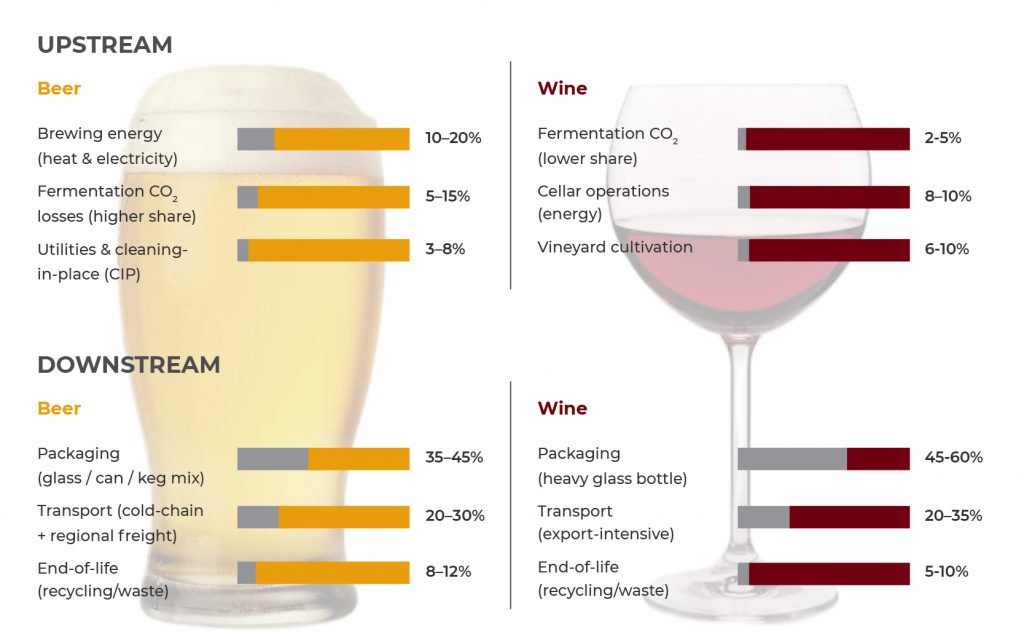
This split is instructive. Wine is shaped primarily by heavy glass and export logistics, while beer’s downstream pressures stem from packaging diversity and cold-chain dependence.
A. Material Innovation and Lightweighting
Packaging redesign is accelerating where producers can capture measurable emission reductions without compromising product stability. Lightweight glass is the most active area in wine: several European lines now run bottles in the 350–420 g range, reducing glass-related emissions substantially for mid-tier SKUs. Some wineries are evaluating fibre-based shells and hybrid composite formats that lower embodied carbon while remaining compatible with standard filling infrastructure.
Beer, by contrast, is emphasising circular aluminium. Cans manufactured with 70–90% recycled content are gaining market share, lowering manufacturing emissions and improving logistical efficiency. Reusable formats — stainless kegs, growlers, and refillable glass — continue expanding where collection systems are robust, especially in regional markets with deposit legislation.
B. Logistics Innovation and Distribution Efficiency
Transport optimisation is emerging as a targeted intervention with category-specific levers. Breweries are reworking their cold-chain strategies: improved insulation, phase-change cooling solutions, and SKU-level formulation adjustments that support ambient-stable distribution. These shifts reduce chilled transport loads, which are significant contributors in beer.
For wine, the largest gains come from bulk shipping, where wine is transported in flexitanks and bottled closer to market. This model, increasingly adopted in the UK, Canada, and parts of Asia, reduces freight emissions materially and allows producers to pair transport rationalisation with bottle lightweighting. Digital logistics tools — carbon modelling, pallet-density optimisation, and route analytics — are being deployed across both categories to fine-tune emission performance in real time.
C. Circular Packaging and Reuse Systems
Circularity continues to mature unevenly across beer and wine. Beer’s established infrastructure gives it a head start: keg ecosystems achieve return rates exceeding 90% in regulated markets, and refillable bottle lines are being expanded in regional clusters where closed-loop distribution is economically viable. Retail-led growler programs reduce single-use packaging for localised volumes.
Wine’s adoption curve is earlier but notable. On-premise wine-on-tap systems reduce packaging intensity substantially, and bag-in-box formats — while traditionally associated with entry-tier wines — are gaining traction for mainstream categories due to their lower material demands and logistics efficiency.
D. Upstream Innovation as a Multiplier for Downstream Gains
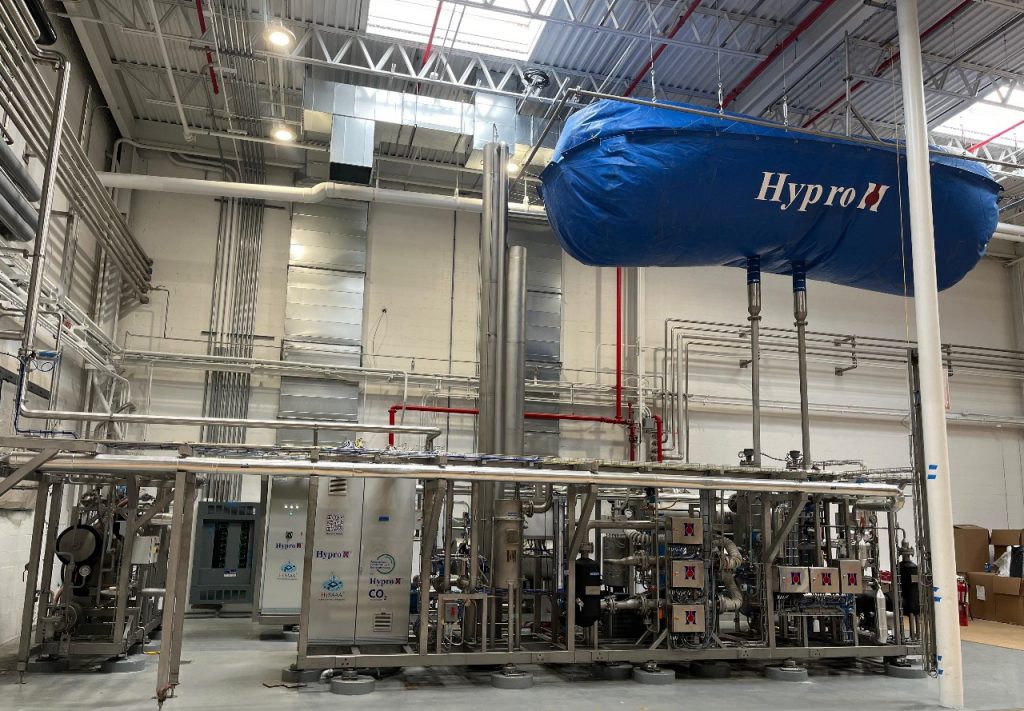
Although most new investment is flowing into packaging and distribution, producers are increasingly acknowledging the importance of upstream optimisation. Lowering Scope 1 emissions strengthens lifecycle metrics and increases the effectiveness of downstream redesign.
Strategically, these systems lower the operational footprint against which packaging, transport, and circularity improvements are measured. This upstream stability — high recovery efficiency, consistent purity output (99.998% v/v), and reliable 24/7 operability — allows producers to extract greater environmental returns from downstream innovation.
Completing the Sustainability Loop
Packaging decisions, logistics design, and recycling systems shape most of the downstream footprint — but real outcomes depend on how consumers participate in the process. Return rates, disposal behaviour, and format choices directly influence whether materials enter high-quality recovery streams or are lost as waste.
Sustainability in beer and wine is not defined by any single stage; it emerges when production, packaging, transport, and consumer action reinforce one another across the value chain.