#biofuel #yeast #brewery #CO2
Yeast based biofuel production: opportunities and challenges of converting waste into renewable energy
Yeast based biofuel production is playing an increasingly important role in the global transition toward renewable energy and circular resource utilization. As industries seek alternatives to fossil fuels, attention is shifting toward biological processes capable of converting agricultural residues, food waste, industrial byproducts, and other organic materials into valuable energy products.
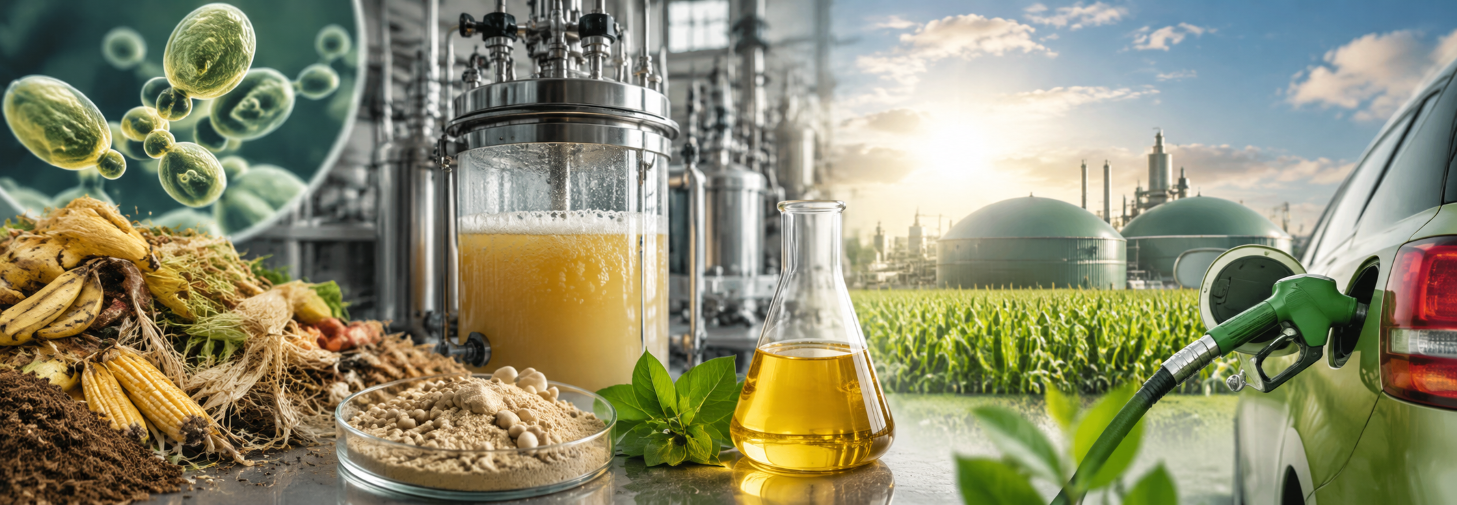
At the heart of many of these processes is yeast, a microorganism long associated with fermentation but now recognized as a critical enabler of modern biofuel technologies. From bioethanol production to emerging pathways for biodiesel, biogas, and biomethane, yeast helps transform renewable carbon sources into usable fuels while creating opportunities for greater resource efficiency.
As waste-derived feedstocks gain importance, however, producers face new challenges related to fermentation performance, process stability, and yield optimization. Understanding these challenges, and the innovations addressing them, is becoming essential for the future of renewable fuel production.
Why yeast remains the backbone of modern biofuel production
Yeast-based biofuel production has evolved significantly over the past few decades, yet one factor has remained remarkably consistent: the industry’s reliance on yeast as the primary biological catalyst.
From large-scale bioethanol facilities to emerging renewable fuel technologies, yeast continues to play a central role in converting renewable carbon sources into commercially valuable fuels.
A proven industrial workhorse
The continued success of biofuel production using yeast is not accidental. Yeast combines high fermentation efficiency with operational reliability, allowing producers to achieve consistent performance across a wide range of industrial conditions.
Unlike many microorganisms that require highly controlled environments, yeast has demonstrated the ability to perform reliably at commercial scale, making it one of the most trusted tools in industrial fermentation.
Its ability to efficiently convert sugars into fuel products, combined with decades of operational knowledge, has helped establish industrial yeast fermentation as the foundation of modern biofuel manufacturing.
Evolving alongside biofuel technologies
While the importance of yeast has remained constant, its role has expanded considerably as biofuel technologies have progressed beyond conventional feedstocks.
|
Biofuel Generation
|
Feedstock Used
|
Yeast Implementation
|
|---|---|---|
|
First Generation (1G)
|
Food crops (corn, sugarcane)
|
Standard Saccharomyces cerevisiae converts simple hexose sugars into bioethanol.
|
|
Second Generation (2G)
|
Agricultural waste (straw, stover, lignocellulosic biomass)
|
Genetically engineered and non-conventional yeasts ferment complex pentose sugars such as xylose.
|
|
Advanced Biofuels
|
Diverse biomass streams and oils
|
Oleaginous yeasts such as Yarrowia lipolytica synthesize lipids for biodiesel and sustainable aviation fuel (SAF) production.
|
This progression demonstrates an important shift within yeast-based biofuel production. As industries move toward waste-derived feedstocks and advanced renewable fuels, yeast is no longer limited to fermenting simple sugars.
Modern strains are increasingly engineered to process more complex substrates, improve conversion efficiency, and support emerging fuel pathways that were previously considered commercially challenging.
More than a microorganism
The effectiveness of yeast-based biofuel production depends not only on selecting the right strain but also on maintaining its health and performance throughout the fermentation cycle. Even highly efficient yeast can underperform when propagation, storage, and pitching practices are not properly managed.
For this reason, successful biofuel operations increasingly view yeast not as a consumable ingredient, but as a valuable biological asset that requires careful management to deliver consistent fuel yields and process stability.
Effective yeast management is critical for consistent biofuel production
In industrial biofuel production, yeast performance depends on far more than the characteristics of the strain itself. Throughout the fermentation cycle, yeast is exposed to temperature fluctuations, osmotic stress, nutrient limitations, toxic compounds, and microbial contamination. Over time, these conditions can affect yeast vitality, fermentation efficiency, and overall process stability.
When yeast performance declines, so does plant performance
Poor yeast management often reveals itself through operational symptoms rather than equipment failures. Reduced fermentation efficiency, incomplete sugar conversion, inconsistent biofuel yields, and longer processing times can all stem from declining yeast health.
In more severe cases, contamination or poorly controlled yeast populations may result in batch losses, product quality variations, and increased operating costs.
For producers operating at industrial scale, maintaining a healthy and consistent yeast population is therefore not simply a biological concern. It is a business requirement.
Creating the right conditions for yeast success
To support reliable fermentation performance, producers typically focus on three key areas:
- Yeast propagation to develop sufficient quantities of healthy, active cells.
- Yeast storage to preserve viability before fermentation.
- Yeast pitching to ensure the right yeast concentration enters the process at the right time.
Together, these practices help reduce process variability, improve sugar conversion, and support stable biofuel production.
As fermentation facilities scale up, structured yeast handling becomes increasingly important. Maintaining yeast viability between batches, preparing healthy cell populations, and ensuring consistent pitching rates often require dedicated infrastructure rather than manual intervention.
Hypro Yeast Management Plant is designed to support these functions through integrated yeast propagation, storage, and pitching capabilities, helping create conditions for improved fermentation consistency and process reliability.
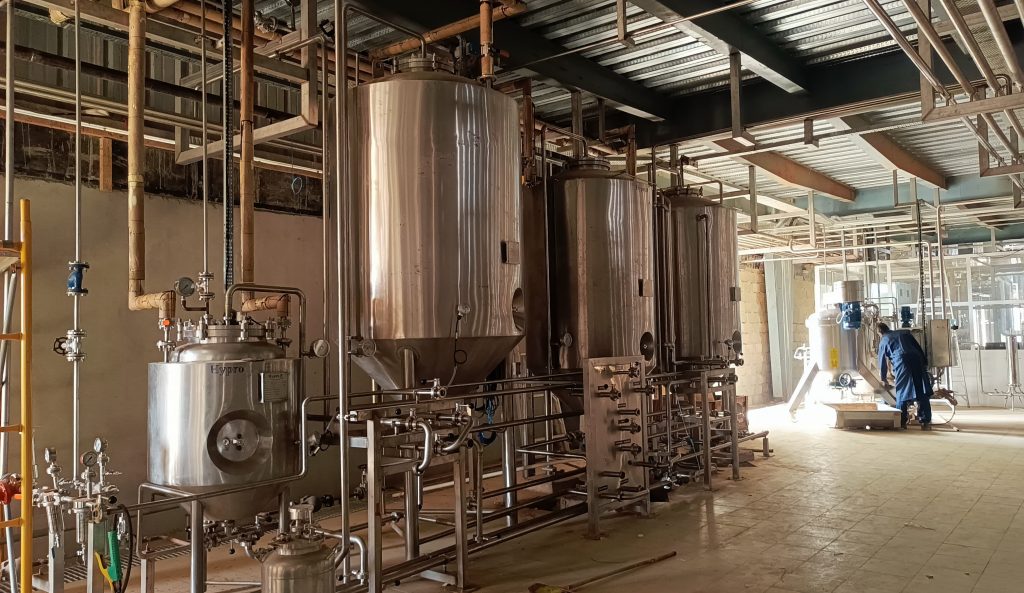
With effective yeast management in place, industries can utilize fermentation across an expanding range of renewable fuel pathways, from conventional bioethanol production to emerging biodiesel, biogas, and biomethane applications.
Applications of yeast in biofuel production
The role of yeast in renewable energy extends far beyond a single fuel pathway. Different yeast strains possess unique metabolic capabilities, allowing them to contribute to the production of liquid fuels, renewable gases, and next-generation fuel feedstocks.
As a result, yeast based biofuel production continues to expand across multiple sectors of the bioeconomy.
Biodiesel: expanding the role of oleaginous yeasts
Unlike conventional biodiesel pathways that rely heavily on vegetable oils and animal fats, oleaginous yeasts offer an alternative biological route for renewable fuel production.
Key advantages include:
- Ability to accumulate large quantities of intracellular lipids.
- Potential utilization of low-value organic feedstocks.
- Reduced dependence on conventional oil crops.
- Opportunities to support future biodiesel and sustainable aviation fuel (SAF) pathways.
Biogas and biomethane: supporting waste-to-energy systems
The contribution of yeast to biogas and biomethane production is often less visible but remains important. In many waste-to-energy pathways, yeast participates in the early stages of biomass conversion by helping break down and ferment organic substrates before they enter downstream biological processes.
Its role becomes particularly valuable when processing:
- Food waste
- Agricultural residues
- Industrial organic byproducts
- Mixed organic waste streams
By helping convert complex organic materials into more readily usable intermediates, yeast supports the overall efficiency of downstream biogas and biomethane production systems.
As biofuel technologies continue to evolve, the versatility of yeast is enabling its adoption across an increasingly diverse range of renewable fuel applications.
This growing flexibility becomes particularly important as industries shift their attention toward waste-derived feedstocks capable of supporting both energy production and circular resource utilization.
Why waste feedstocks are becoming the future of biofuel production
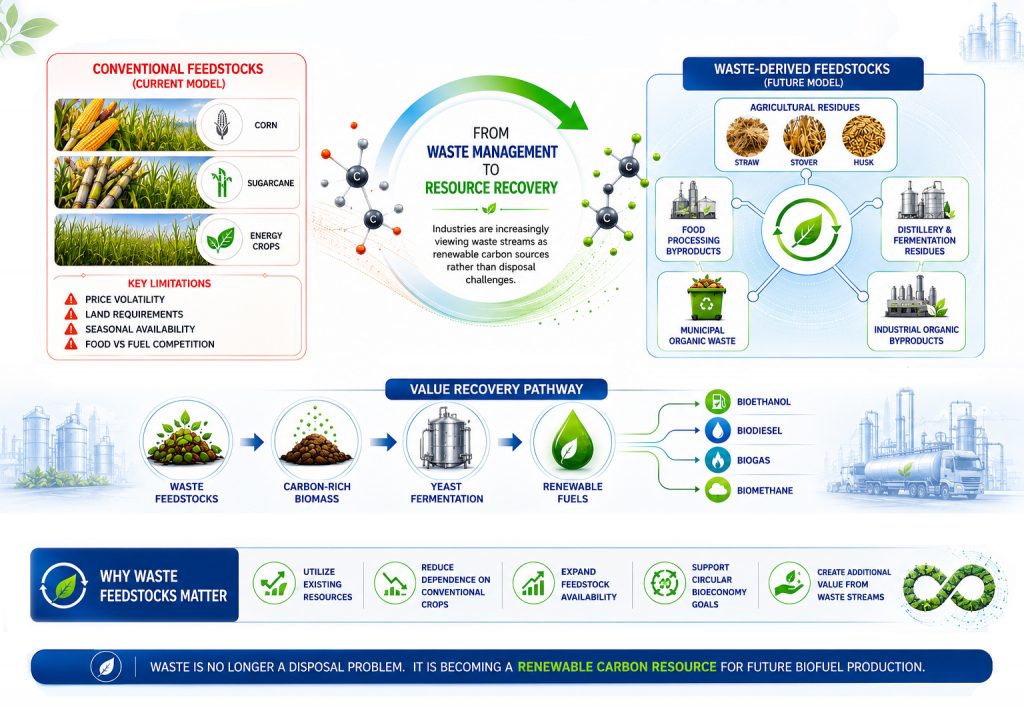
For decades, commercial biofuel production has relied heavily on conventional feedstocks such as corn, sugarcane, and other energy crops. While these resources have enabled the growth of renewable fuels, they also present practical limitations, including price volatility, land-use requirements, seasonal availability, and competition with food supply chains.
As a result, increasing attention is being directed toward feedstocks that have historically been treated as waste rather than valuable resources.
A vast and underutilized carbon resource
Waste-derived feedstocks can originate from agricultural, industrial, municipal, and food-processing activities, creating a large and often underutilized pool of renewable carbon resources.
Many of these streams contain significant amounts of carbon-rich material that can be converted into renewable fuels through biological processes. Consequently, industries are beginning to view waste not merely as a disposal challenge, but as a potential source of energy, revenue, and resource recovery.
For producers exploring yeast-based biofuel production, waste streams offer several advantages:
- Reduced dependence on conventional energy crops
- Greater feedstock diversity and availability
- Opportunities to recover value from existing operations
- Improved alignment with circular bioeconomy initiatives
Moreover, many of these resources already exist within agricultural, food-processing, and industrial supply chains, making them attractive candidates for future biofuel development.
However, this opportunity comes with a trade-off. Unlike traditional sugar- and starch-based feedstocks, waste-derived materials are inherently less predictable. Their composition can vary significantly, and they often contain compounds that interfere with fermentation performance.
As a result, converting waste into renewable energy is rarely as straightforward as it may appear. Successfully utilizing these feedstocks requires overcoming a new set of technical challenges, many of which directly affect yeast performance and biofuel yields.
The challenges of yeast-based biofuel production from waste feedstocks
While waste-derived feedstocks create exciting opportunities for renewable fuel production, they also introduce complexities that are rarely encountered with conventional feedstocks such as corn or sugarcane.
For producers pursuing yeast-based biofuel production, the challenge lies not only in accessing waste streams but also in converting them efficiently and consistently at industrial scale.
Why waste feedstocks are more difficult to process
Unlike refined sugar and starch sources, waste materials often contain compounds that interfere with fermentation performance. In addition, their composition can vary significantly depending on origin, season, storage conditions, and processing methods.
Some of the most common challenges include:
|
Challenge
|
Impact on Yeast
|
Effect on Biofuel Production
|
|---|---|---|
|
Inhibitory compounds (furfural, HMF, organic acids, phenolics)
|
Reduce yeast activity and viability
|
Lower yields and slower fermentation
|
|
Variable feedstock composition
|
Creates unstable fermentation conditions
|
Inconsistent fuel output
|
|
Nutrient imbalances
|
Limits yeast growth and metabolism
|
Reduced productivity
|
|
Microbial contamination
|
Competes with yeast for nutrients
|
Batch losses and quality issues
|
|
Recalcitrant biomass structures
|
Restricts access to fermentable sugars
|
Lower conversion efficiency
|
The cost of fermentation instability
Even when waste streams contain significant amounts of recoverable carbon, poor fermentation performance can quickly erode economic viability. Producers may experience longer processing times, lower sugar conversion rates, inconsistent fuel quality, and increased operational costs.
Consequently, successful utilization of waste-derived feedstocks requires more than simply adapting existing fermentation systems. Yeast must be capable of performing under conditions that are often harsher and less predictable than those encountered in conventional biofuel production.
These challenges do not diminish the potential of waste-based fuels. Rather, they highlight the growing importance of advanced yeast technologies designed to improve tolerance, stability, and overall fermentation performance.
Engineered yeast strains are expanding biofuel possibilities
Traditional Saccharomyces cerevisiae has played a central role in commercial bioethanol production for decades.
However, as the industry shifts toward agricultural residues, food-processing waste, and industrial byproducts, conventional yeast often struggles to fully utilize available carbon sources and maintain performance under increasingly demanding fermentation conditions.
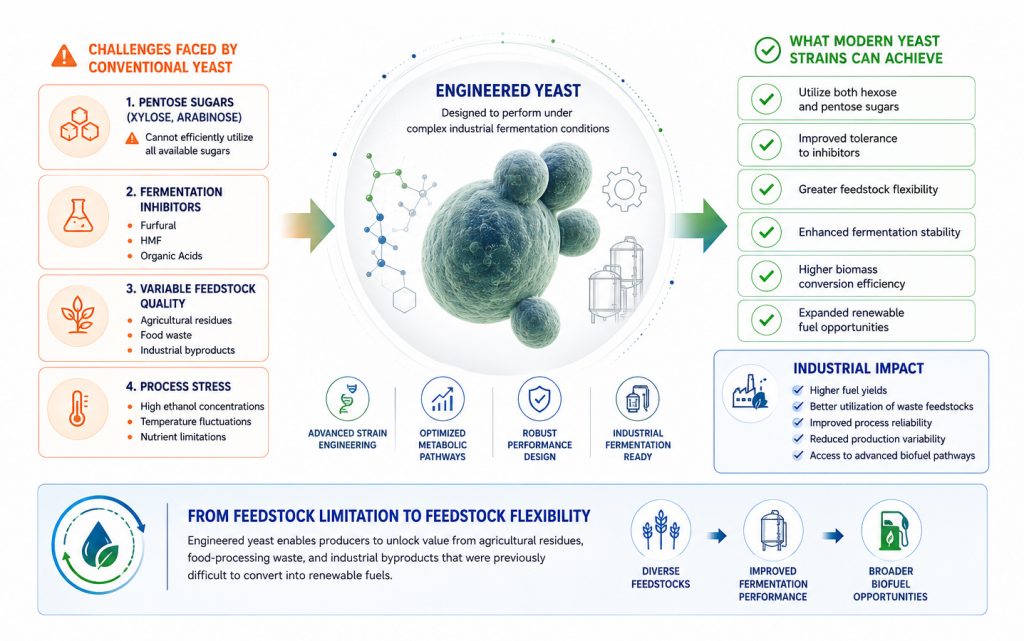
To overcome these limitations, researchers and technology developers are engineering yeast strains with enhanced fermentation capabilities. Modern strains can utilize a broader range of sugars, tolerate inhibitory compounds more effectively, and maintain stability under conditions that would challenge conventional yeast.
As a result, producers can recover greater value from waste-derived feedstocks while improving overall biomass-to-fuel conversion efficiency.
These advancements are helping expand the scope of yeast-based biofuel production beyond traditional feedstocks. Some engineered strains are designed to process both hexose and pentose sugars, unlocking more energy from lignocellulosic biomass.
Others are being explored for applications involving microbial lipids, renewable diesel, and sustainable aviation fuel (SAF), creating new opportunities for advanced biofuel development.
As feedstock diversity continues to increase, engineered yeast is emerging as a key enabler of both process flexibility and renewable fuel innovation. However, maximizing the benefits of these advanced strains also requires precise control over fermentation conditions and process performance.
Intelligent monitoring and process optimization in modern biofuel facilities
Advanced yeast strains can significantly improve fermentation performance, but biological capability alone does not guarantee consistent results. To maximize fuel yields and process efficiency, producers must also maintain precise control over operating conditions throughout the fermentation cycle.
Turning data into better fermentation performance
Modern biofuel facilities increasingly rely on sensors, automation, and process analytics to monitor key fermentation parameters in real time, including:
- Yeast viability and activity
- Fermentation temperature
- pH levels
- Nutrient availability
- Sugar consumption rates
- Ethanol production trends
This level of visibility allows operators to identify deviations before they affect production performance. Rather than reacting to problems after yields decline, facilities can make timely adjustments that help maintain fermentation stability and improve overall process efficiency.
As biofuel operations continue to adopt more complex feedstocks and advanced yeast strains, intelligent monitoring is becoming an increasingly important tool for reducing variability and supporting consistent plant performance.
While process optimization helps maximize fuel yields, fermentation itself produces another valuable output that is often overlooked: carbon dioxide.
Fermentation CO2: The overlooked value stream in biofuel production
This shift represents more than an additional revenue opportunity. It reflects a broader movement toward resource-efficient manufacturing, where value is extracted not only from the primary product but also from process byproducts.
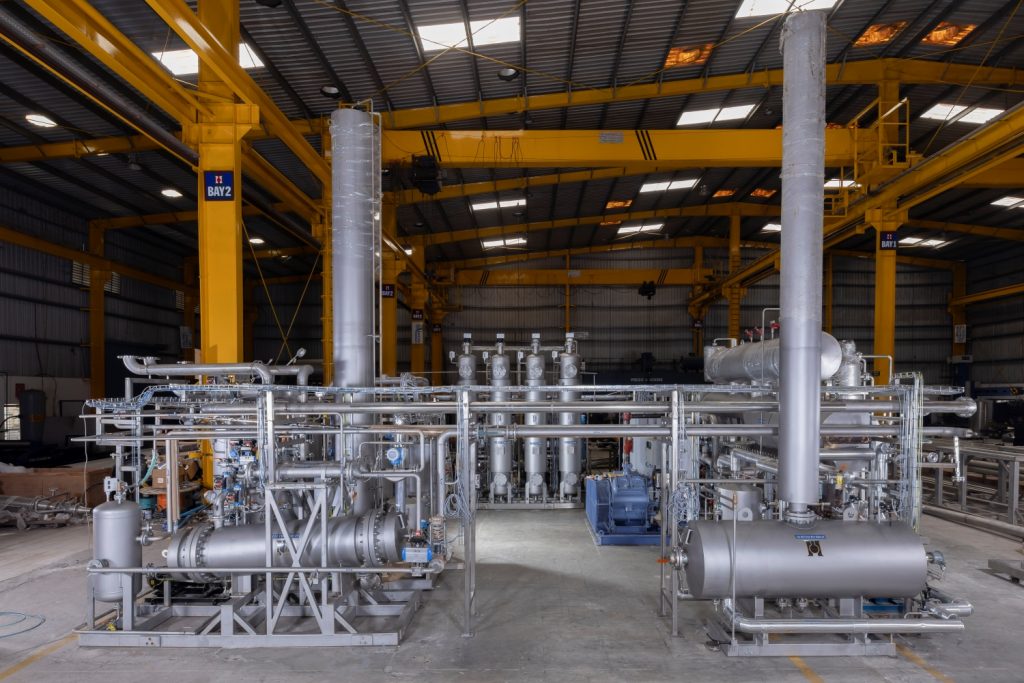
By transforming what was once considered a waste stream into a marketable industrial product, such systems help strengthen both the environmental and economic performance of modern fermentation facilities.
Hypro CO2 recovery plants are designed to deliver up to 99.998% v/v liquid CO2 purity, making the recovered gas suitable for demanding industrial and food-grade applications.
The systems are also engineered for high energy efficiency, helping producers minimize long-term operating costs while maximizing resource recovery. In addition, PLC-based automation with remote monitoring capabilities provides operators with greater control over plant performance, supporting reliable, efficient, and responsive operation.
As biofuel technologies continue to evolve, maximizing value from every available resource, including feedstocks, energy, and byproducts, will become an increasingly important factor in long-term competitiveness.
The Future of Yeast Based Biofuel Production
As the biofuel industry continues to evolve, yeast will remain at the center of efforts to convert renewable carbon into sustainable energy. Advances in strain engineering, process optimization, and resource recovery are enabling producers to extract greater value from increasingly complex feedstocks.
At the same time, technologies that improve fermentation efficiency and recover valuable byproducts are strengthening both sustainability and plant economics. Together, these developments are positioning yeast-based biofuel production as a key contributor to a more circular and resilient energy future.
Related Posts

How Modern Hop Processing Maximizes Extraction Efficiency and Eliminates Batch Variability
Agricultural crop volatility presents a severe operational risk to commercial...
Read More
Brewery Operations: 5 Common Challenges
Discover 5 critical challenges in brewery operations that growing breweries...
Read More
Beer vs Wine: Packaging and Transportation Emissions
Packaging and transportation emissions increasingly determine how sustainability outcomes vary...
Read More