


#CO2 #PowerPlant #FlueGas #Sustainability

From Pollution to Profit: How Power Plants Can Monetize Recovered CO2

Power plant operations are among the largest contributors to global carbon emissions. Fueled by coal, natural gas, and oil, these power plants release significant amounts of CO2 into the atmosphere with every megawatt generated.

According to the International Energy Agency (IEA), electricity production accounts for nearly 40% of global CO2 emissions, placing power plants squarely at the center of climate change challenges.

Power Plant CO2 Recovery

What if these emissions could become a valuable asset instead of a liability? This is where CO2 recovery comes in – a process designed not only to cut emissions but also to unlock a new source of revenue.

Rather than venting carbon into the atmosphere, a power plant can capture it and supply industries that depend on high-purity CO2. Manufacturers like Hypro specialize in advanced CO2 recovery systems that help power plants transform their emissions into a profitable, high-demand commodity.

With the rising need for Carbon Capture and Utilization (CCU), power plants now have the chance to transform from major emitters into crucial suppliers for a growing carbon-based economy – turning pollution into profit.

Why Should Power Plants Consider CO2 Recovery?

Revenue Generation from CO2 Sales

Historically, power plants have treated CO2 as an unavoidable byproduct. Today, however, that same CO2 is in high demand. From food and beverages to oil recovery and chemical production, industries worldwide rely on steady supplies of carbon dioxide.

By adopting CO2 recovery solutions offered by Hypro, a power plant can capture emissions and sell the recovered gas to various sectors, generating fresh income from what was once waste.

Industries that purchase CO2 include:

  • Food and beverage producers for carbonation and packaging.
  • Oil fields using CO2 for Enhanced Oil Recovery (EOR).
  • Chemical and fertilizer plants in processes like ammonia and urea production.
  • Greenhouses to accelerate plant growth.

For any power plant, this shift turns carbon emissions into a profitable product, supporting both business growth and sustainability goals.

Diversification of Business Model

A traditional power plant relies almost entirely on electricity sales. But with fluctuating tariffs, evolving regulations, and the rise of renewable energy, this single-stream model is no longer enough to ensure long-term stability.

This is where Hypro steps in – enabling power plants to diversify their revenue by adding a valuable alternative: CO2 recovery. Through advanced technology, Hypro helps capture emissions directly from power plants and convert them into food-grade CO2 with 99.998% v/v purity, opening doors to lucrative markets like food, beverages, and industrial applications.

By tapping into this second revenue stream, power plants can reduce their reliance on unpredictable power markets while strengthening their financial resilience. The result is a forward-thinking energy model that balances electricity generation with profitable carbon recovery, all while actively cutting down on emissions.

Transforming Industrial Emissions with Hypro’s CO2 Capture Technology

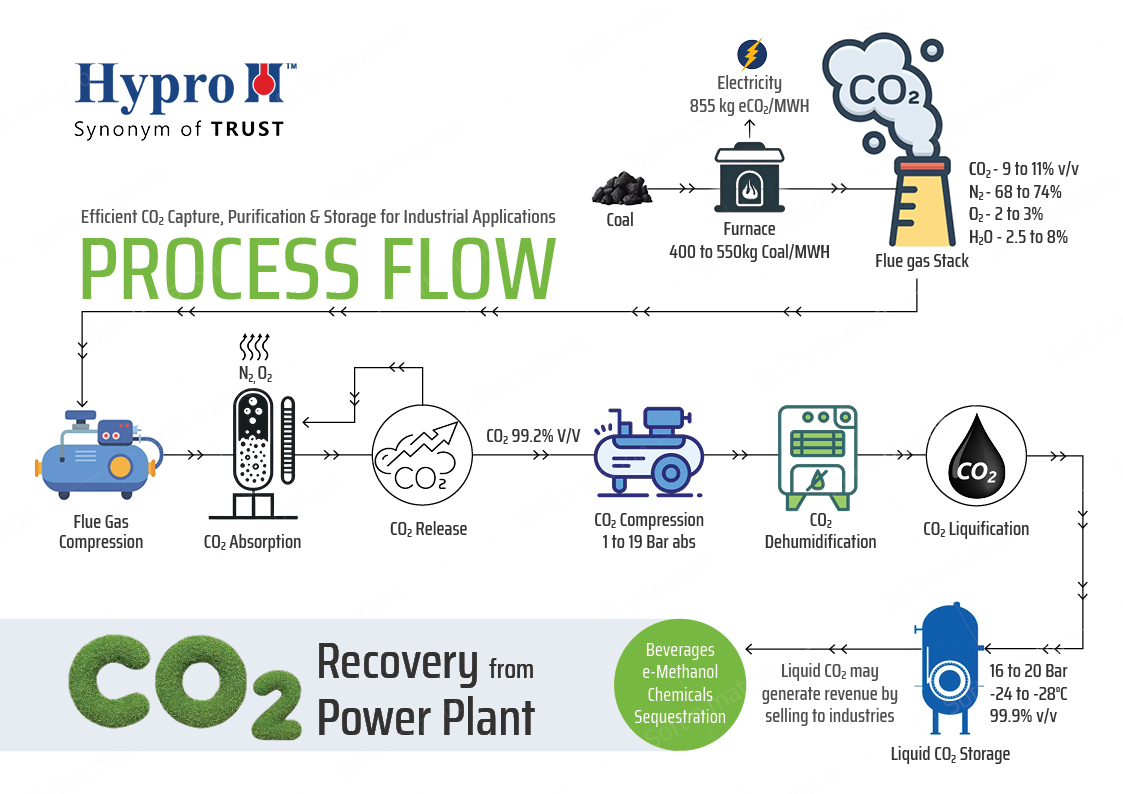
Flue gas from high-temperature industrial processes carries significant CO2 emissions. Instead of releasing this into the atmosphere, it is directed to a CO2 recovery plant where impurities like particulate matter, NO2, and SO₂ are removed, and CO2 is separated from nitrogen and oxygen.

Hypro’s advanced technology captures CO2 at the source and produces food-grade Liquid CO2 with over 99.99% v/v purity. The process uses optimized amines for efficient CO2 absorption and low-energy desorption, minimizing heat consumption and reducing amine degradation.

To ensure longevity, stainless steel columns are used to withstand corrosion from hot amine solutions. Additionally, industries can utilize available waste heat or excess steam to power the system, enhancing overall efficiency.

The recovered CO2 is liquefied and stored in vacuum-insulated tanks, ready for applications such as beverage carbonation, chemical manufacturing, and e-Methanol production – transforming emissions into valuable products.

CO2 released by combustion based on commonly used fuels

Min kg eCO2/Mwh Max kg eCO2/Mwh
CO2 eq/MWh for coal-fired plants
850
986
CO2 eq /MWh for oil-fired plants
670
777
CO2 eq /MWh for gas-turbine plants
420
486
CO2 eq /MWh for co-generation & combined-cycle plants
300
352
CO2 eq /MWh for other gas-fired plants
500
583

Coal-Fired Power Plants: Giants of Energy, Titans of Emissions

Coal-fired power plants have powered economies for over a century, but at a steep environmental cost. These facilities burn coal to generate electricity, releasing enormous amounts of CO2 into the atmosphere.

According to the International Energy Agency (IEA), coal-fired power generation alone accounts for nearly 30% of global CO2 emissions. On average, a coal-fired power plant emits 2.2–2.5 pounds of CO2 per kWh, making them one of the biggest contributors to industrial carbon emissions.

coal fired plant

Yet, coal-fired power plants don’t have to be just emitters; they can also be part of the solution. With carbon capture technologies, CO2 from power plants can be repurposed for enhanced oil recovery (EOR) or converted into synthetic fuels and chemicals, turning pollution into profit. 

Some research suggests that captured CO2 can even be mineralized into solid carbonates for construction materials, creating new revenue streams while reducing emissions. Although these solutions require significant investment, they offer a glimpse of a future where even the most carbon-intensive power sources can contribute to sustainability.

Natural Gas Power Plants: The Lesser Evil or a Hidden Opportunity?

Natural gas power plants are often touted as the cleaner alternative to coal, and for good reason. They produce about 0.9–1.2 pounds of CO2 per kWh, nearly half the emissions of a coal-fired power plant. However, this doesn’t make them entirely green – especially when factoring in methane leaks from natural gas extraction and transportation, which can have an even greater warming effect than CO2.
Interestingly, the CO2 emitted from natural gas power plants isn’t just a byproduct – it’s a resource. Many industries rely on purified CO2 for food and beverage carbonation, water treatment, and chemical manufacturing.
Moreover, studies indicate that integrating direct air capture (DAC) with natural gas power plants can significantly reduce net emissions while generating high-purity CO2 for industrial applications. By investing in carbon capture and utilization (CCU), natural gas power plants can transition from being mere polluters to key players in a circular carbon economy, where emissions are repurposed rather than wasted.

Oil & Gas Industry: Refining the Future of Carbon Utilization

Refineries and petrochemical plants are the backbone of modern industry, supplying fuels, plastics, and countless synthetic materials. However, this comes at a high environmental cost – oil refineries and petrochemical facilities collectively emit 2–3 tons of CO2 per ton of refined product. 

The high energy demand and chemical processes involved in refining crude oil into usable products make this sector a significant carbon contributor. Surprisingly, this industry has also pioneered CO2 utilization. Enhanced oil recovery (EOR), a process where CO2 is injected into oil wells to boost extraction rates, has been in use for decades.

Additionally, refineries are exploring CO2 conversion into synthetic fuels, polycarbonate plastics, and industrial solvents. According to a McKinsey & Company report, advanced carbon capture technologies could create a multi-billion-dollar market for CO2 – derived fuels and chemicals. By integrating more CCU solutions, the oil and gas sector can turn emissions into economic assets, mitigating its environmental footprint while maintaining profitability.

Chemical & Fertilizer Plants: Turning CO2 Emissions into Industrial Gold

The chemical and fertilizer industries, particularly ammonia, hydrogen, and methanol production, are another major source of CO2 emissions. Ammonia plants, essential for fertilizer production, release around 1.8 tons of CO2 per ton of ammonia produced, while global hydrogen production contributes nearly 830 million metric tons of CO2 annually. The culprit? Steam methane reforming (SMR), a process that extracts hydrogen from natural gas while releasing CO2 as a byproduct.
Chemical fertilizer plant
Yet, these industries also present some of the best opportunities for CO2 reuse. Captured CO2 is a key ingredient in urea production, an essential fertilizer component. Methanol plants are increasingly adopting carbon recycling methods, using CO2 as a feedstock for producing chemicals and fuels.
The Carbon XPRIZE competition has showcased breakthrough technologies that transform CO2 into high-value materials such as carbon fiber and bio-based plastics, proving that emissions can be converted into profitable commodities. With advances in CCU, the sector has the potential to transform waste CO2 into valuable products, helping to close the carbon loop in industrial manufacturing.

The Power Plant and Industrial Shift to a Circular Carbon Economy

Many of these industries tells a two-sided story – while they are among the largest CO2 emitters, they are also at the forefront of carbon utilization. From coal-fired power plants to cement kilns, oil refineries to fertilizer plants, the shift toward carbon circularity is no longer just a vision; it is a necessity. 

As studies continue to highlight the economic potential of CO2 conversion, businesses that invest in pollution-to-profit strategies will not only reduce their carbon footprint but also unlock new revenue streams in the evolving green economy.

Related Posts


Share this article

Share on facebook
Facebook
Share on twitter
Twitter
Share on linkedin
LinkedIn
Share on whatsapp
WhatsApp
Share on email
Email