#cryogenic #sub-zero #storagetanks
Cryogenic Thermal Performance: Design, Storage & Heat Control
Keeping a cryogenic system cold is not simply a matter of preventing heat from getting in. At temperatures below about -150°C, even small thermal loads can influence boil-off, refrigeration demand, and the stability of the system. The challenge becomes more complex because heat does not follow a single path.
It can travel through structural supports, piping, instrumentation, residual gas, and other system connections, while radiation can transfer energy across spaces where there is no physical contact at all. Insulation remains fundamental, but its performance depends on how the entire system is designed around it.
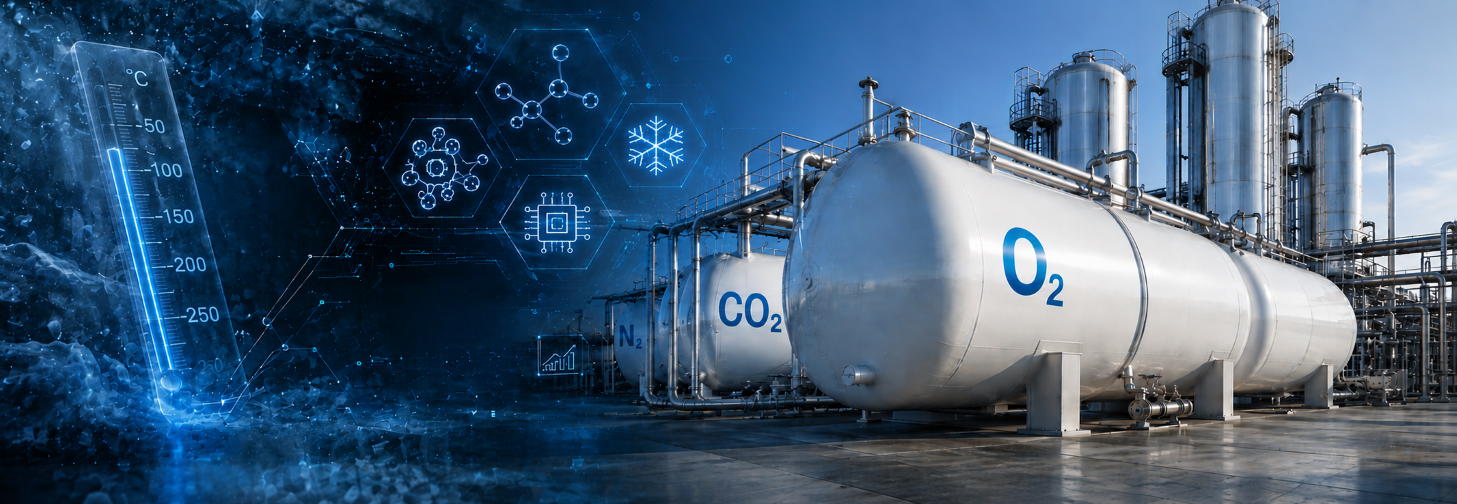
This is why cryogenic thermal performance has to be considered as a system-level problem. Material behavior changes at low temperatures, thermal paths become increasingly important, and details that may appear insignificant at ambient conditions can become meaningful sources of heat ingress.
The engineering objective, then, is not merely to achieve a low heat leak on paper. It is to control the complete thermal environment around the cold system, from material selection and structural design to vacuum quality and operating conditions. Understanding where that heat comes from is the logical place to begin.
The fundamentals of heat transfer in cryogenic environments
Once a cryogenic system is operating, heat is constantly trying to move from the warmer surroundings toward the cold region.
How much heat reaches the system, and through which path, depends on the materials, geometry, pressure, and fluids involved. Three mechanisms govern this transfer: conduction, convection, and radiation.
They do not contribute equally in every cryogenic system. The design challenge is to understand where each mechanism becomes significant and control the dominant pathways.
Conduction: Heat through the physical structure
Conduction follows the physical connections between warm and cold parts of a system.
In a cryogenic vessel, potential conduction paths include:
- Structural supports connecting the inner and outer vessels
- Piping and process connections
- Electrical and instrumentation leads
- Feedthroughs and other penetrations
The amount of heat conducted depends on factors such as material thermal conductivity, geometry, length, and the temperature difference along the path. A relatively small structural component can therefore become a significant thermal pathway when it directly connects ambient-temperature equipment to the cold vessel.
Residual gas can create another conductive path within a vacuum space. As pressure falls, gas molecules travel farther between collisions, making the quality and stability of the vacuum an important part of thermal performance. This becomes particularly important when the system is designed to rely on vacuum insulation.
Convection: When fluids carry heat
Convection depends on the movement of a fluid, so its importance varies considerably with system configuration. In a well-maintained vacuum-insulated space, the lack of sufficient gas largely suppresses conventional gaseous convection. Within cryogenic fluids, however, fluid movement can redistribute heat through buoyancy-driven flow and boiling.
For storage and process systems, phase change adds another layer to the problem. Heat entering the cryogenic fluid can contribute to evaporation, while the resulting vapor can itself become part of the system’s thermal behavior.
Radiation: Heat across the vacuum
Radiation takes a different route. Unlike conduction and convection, it does not require physical contact or a fluid medium. Thermal energy can pass directly between surfaces across a vacuum.
Its magnitude depends strongly on the absolute temperatures and emissivities of the facing surfaces. This makes the condition and surface properties of the components surrounding a cold vessel important even when there is no direct physical connection between them.
The three mechanisms work together
A cryogenic vessel may use a high vacuum to suppress convection while still receiving heat through structural supports by conduction and across the vacuum space by radiation.
That is why reducing heat leak is not a matter of addressing a single mechanism. The objective is to identify the dominant thermal paths and design the system so that each is controlled appropriately.
The next challenge is deciding what those thermal paths should be made from, how they should be arranged, and where they can unintentionally bypass the primary insulation.
Beyond Simple Insulation: Designing the Complete Thermal Path
Insulation is only one part of cryogenic thermal design. The way a system is supported, connected, sealed, and operated can create additional paths for heat to reach the cold region.
In practice, good thermal performance comes from controlling the complete thermal path, not from the insulation layer alone. The engineering challenge is to make every connection in that path work for the cold system rather than against it.
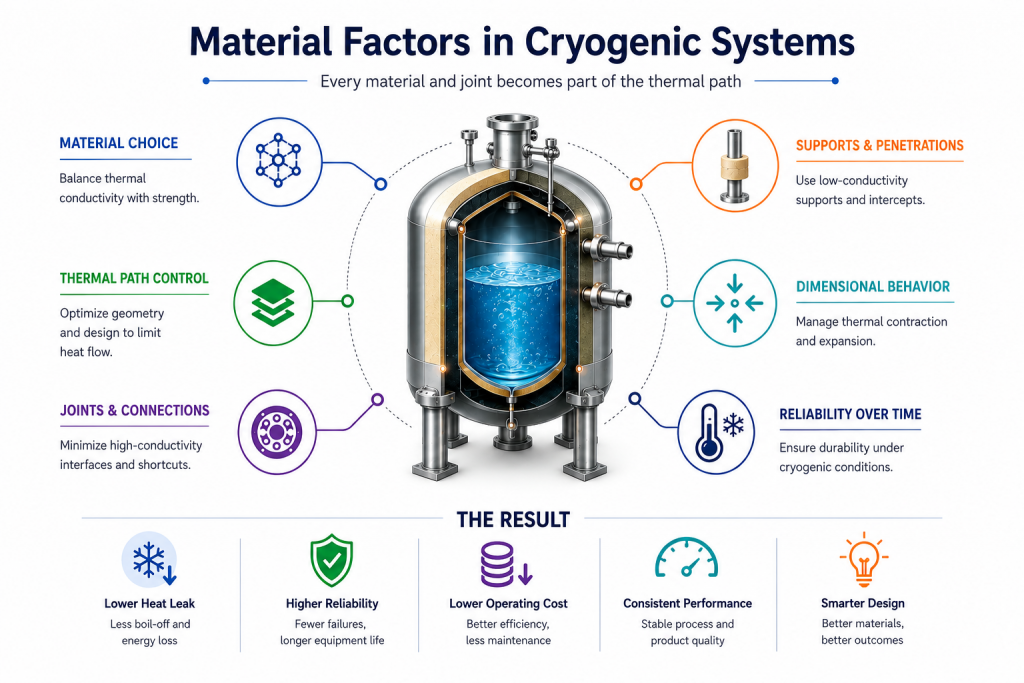
Material selection: Thermal performance starts with the right material
Material selection is not simply a search for the lowest thermal conductivity. Structural strength, dimensional stability, electrical properties, fabrication requirements, and behavior at cryogenic temperatures all have to be considered together.
Materials such as G10 and G10-CR are used in cryogenic applications because they combine useful mechanical strength with low thermal conductivity and electrical insulation properties. Metals such as stainless steel and titanium remain important for structural components, but their low-temperature mechanical and thermal behavior must be accounted for during design.
The material itself, however, is only part of the thermal path. How that material is used, joined, and positioned can have an equally important effect.
Thermal Bridges: Where Good Insulation Gets Bypassed
Supports, instrumentation leads, piping connections, and penetrations can provide a direct route from warmer surroundings to the cold vessel. These thermal bridges are often unavoidable, so the objective is to make them as thermally resistant as practical.
Typical design measures include:
- using low-conductivity support materials
- increasing the effective length of the heat path
- minimizing unnecessary cross-sectional area
- intercepting heat at an intermediate temperature
- carefully designing penetrations and feedthroughs
This is why a low-conductivity material does not automatically create a low-heat-flow connection. Geometry and the complete path matter just as much.
| Thermal design lever | What it controls | Typical engineering concern |
|---|---|---|
|
Material selection |
Conductive heat flow and structural integrity |
Low-temperature property changes |
|
Thermal path design |
Heat through supports and connections |
Thermal bridges |
|
Thermal interception |
Heat reaching the coldest stage |
Boil-off and intermediate heat loads |
|
Vacuum integrity |
Gas conduction within the insulation space |
Leakage outgassing vacuum degradation |
|
Radiation control |
Heat transfer across the vacuum gap |
Surface emissivity and shielding effectiveness |
Vapor Cooling and Thermal Anchoring: Intercept Heat Before It Reaches the Coldest Stage
Not all incoming heat has to reach the coldest component.
Cryogenic systems can use the cold vapor produced by a boiling cryogen to intercept heat at intermediate stages. As the vapor absorbs heat, it warms before being discharged, reducing the thermal load reaching the liquid or coldest components.
Thermal anchoring follows the same principle from a broader system-design perspective. Electrical leads and other conductive paths can be connected to an intermediate-temperature stage so that part of their heat is removed before it reaches the coldest stage.
The principle is simple: intercept the heat early rather than allowing the entire load to arrive at the coldest point.
Vacuum Integrity: The Insulation Must Stay Protected
In a vacuum-insulated cryogenic system, the vacuum is an active part of the thermal design. A loss of vacuum allows residual gas to increase heat transfer, raising the thermal load and potentially increasing cryogen boil-off.
Maintaining that condition requires more than creating a high vacuum during commissioning. Materials inside the vacuum space need controlled outgassing, getters can help absorb residual gases, and vacuum monitoring can provide an early indication of deterioration.
This makes vacuum integrity both a thermal-performance issue and a long-term reliability issue.
Radiation Shielding: The Heat Path Across the Gap
Even when conduction and convection are minimized, thermal radiation can cross the vacuum space between warmer surroundings and the cold vessel.
Multi-layer insulation (MLI) addresses this by using multiple reflective layers separated within the vacuum space, reducing radiative heat transfer toward the cold surface. Vapor-cooled shields provide another layer of protection by intercepting part of that radiative load at an intermediate temperature. Low-emissivity surfaces can further reduce the amount of radiation exchanged between facing surfaces.
Good insulation provides the foundation, but the supports, connections, vacuum space, surfaces, and intermediate stages determine how much of the surrounding heat ultimately reaches the cold system.
Emerging Cryogenic Technologies and Engineering Advances
As cryogenic requirements become more demanding, improving insulation is only one part of the engineering challenge. Advances are also changing how cooling is produced, how low-temperature systems are configured, and how their thermal behavior is predicted before equipment is built.
Closed-Cycle Cooling: Moving Beyond Stored Cryogens
For applications where continuous operation and reduced dependence on liquid-cryogen supply are important, closed-cycle cryocoolers offer a different approach.
Instead of relying on stored cryogen that must be replenished, these systems actively remove heat through a refrigeration cycle. Stirling, Gifford-McMahon, and pulse tube refrigerators represent established closed-cycle approaches, each using a different arrangement to produce cooling.
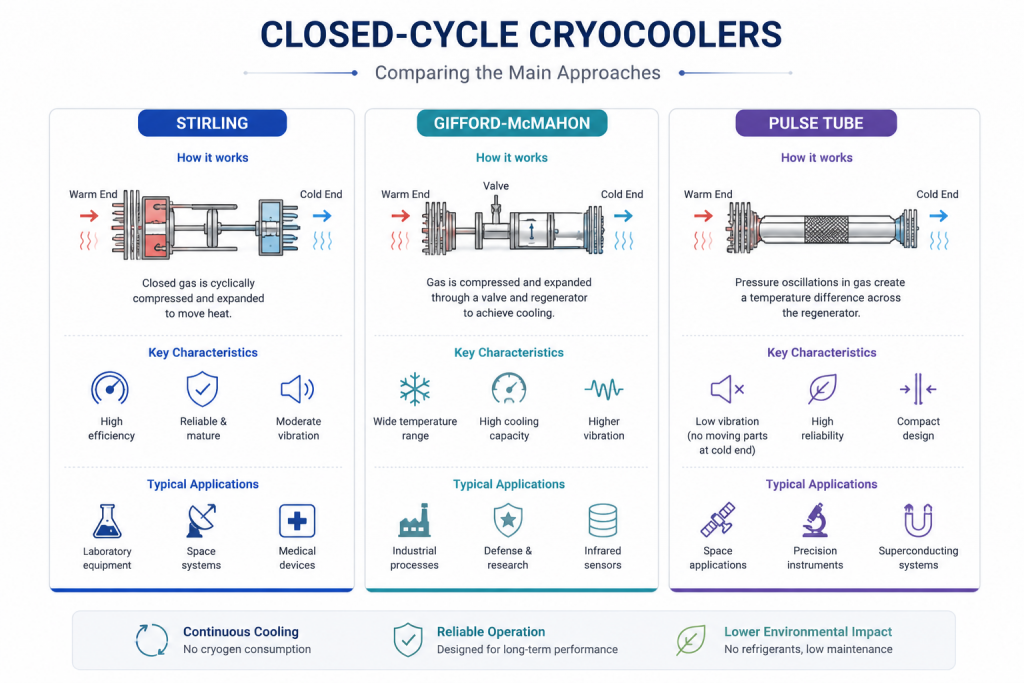
The choice depends on the cooling requirement, system integration, heat rejection, and allowable vibration. Pulse tube refrigerators are notable for having no moving parts at the cold end, which can be advantageous where vibration and cold-end mechanical complexity matter.
Emerging Technologies: Expanding the Cryogenic Possibilities
Advances in cryogenics are also changing the temperature range and refrigeration methods used in specialized applications.
High-temperature superconductors can operate at higher temperatures than conventional low-temperature superconductors, potentially reducing the associated cryogenic requirements in some applications.
Magnetic refrigeration uses the magnetocaloric effect and remains an area of research, with its practical role dependent on application requirements and technology maturity.
Predictive Cryogenic Engineering: Designing Before Building
The most significant advances may not always be visible in the equipment itself. Increasingly, they happen during the design stage.
Computational tools such as computational fluid dynamics (CFD), finite element analysis (FEA), and multiphysics modeling allow engineers to examine heat transfer, fluid flow, and structural behavior together. This can help predict temperature distributions, boil-off behavior, and thermal loads before the physical system is fabricated.
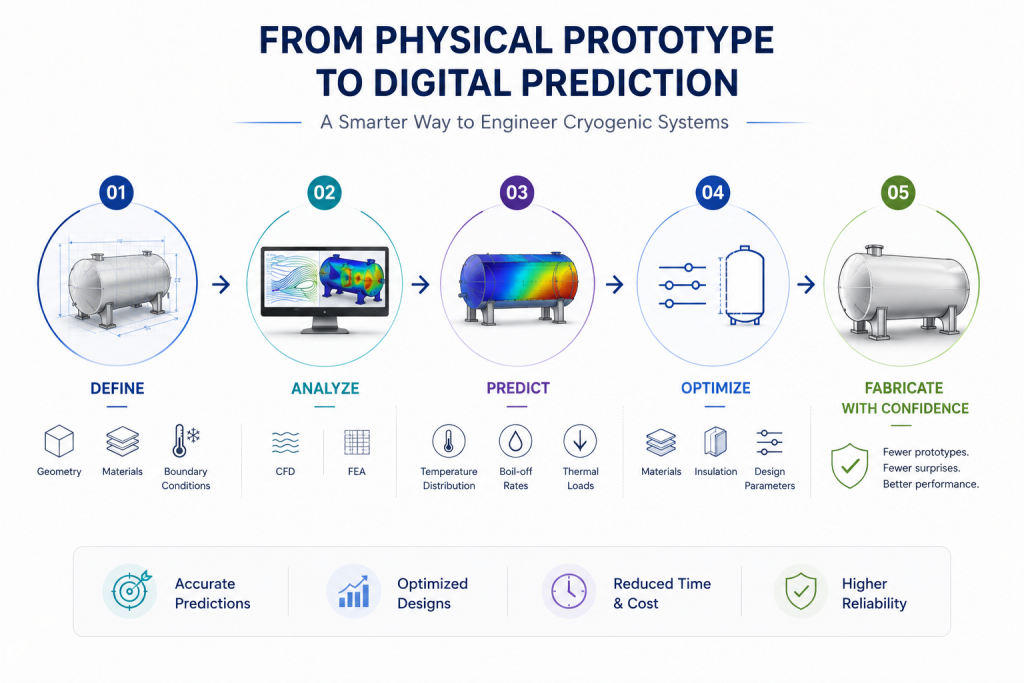
The value lies in evaluating geometry, materials, insulation, and other design parameters before fabrication, allowing engineers to identify weaknesses earlier and compare alternatives while changes are still easier to make.
This shifts part of cryogenic engineering from reacting to measured performance toward predicting performance before the system exists. For complex projects, this makes thermal design a more deliberate part of equipment development rather than a problem addressed only during testing or commissioning.
Cryogenic Storage Tanks for O2, N2, and CO2
Cryogenic storage is where thermal performance becomes an operating requirement, not simply a design objective. A storage tank has to limit heat ingress while maintaining the required product condition, managing pressure, accommodating thermal contraction and expansion, and remaining reliable through repeated operating cycles.
That brings together many of the principles discussed throughout this article. Insulation reduces heat transfer, vacuum limits gas conduction and convection, while the vessel structure, supports, connections, and other penetrations must be designed so that they do not create unnecessary thermal paths.
Material selection also becomes critical because components have to withstand cryogenic temperatures while maintaining the required mechanical integrity.
Hypro Cryogenic Storage Tanks
Designed in accordance with AD 2000, EN 13458-1, and ASME standards, and certified by U, CE, and PESO, Hypro cryogenic tanks combine high-quality SS 304 interiors with vacuum and perlite insulation to achieve reliable thermal isolation, structural integrity, and consistent cryogenic storage performance.
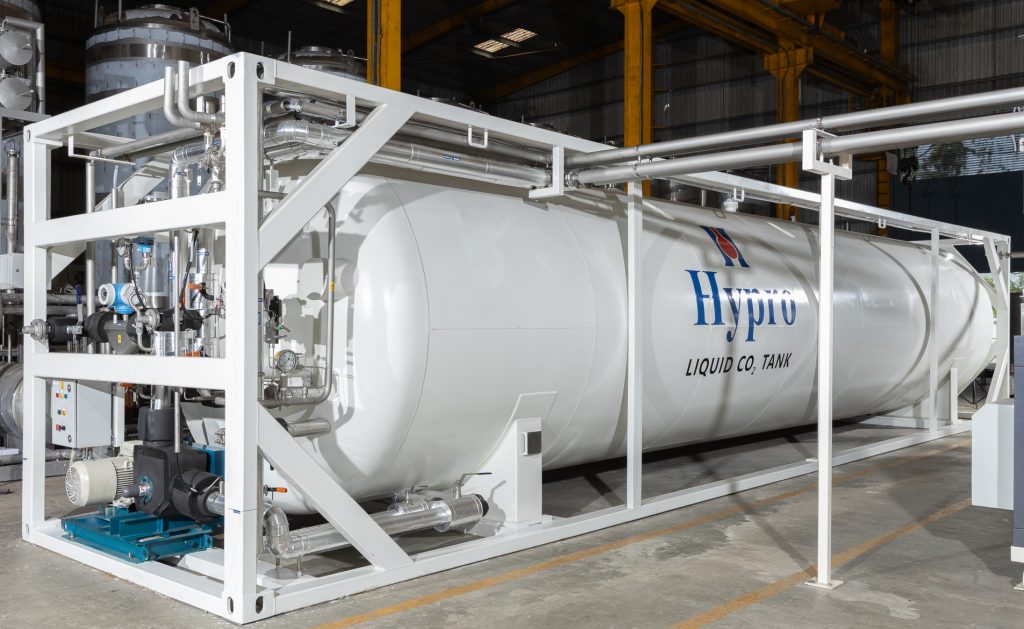
The design brings the cold inner vessel, insulation system, structural components, and external environment together as one thermal system, recognizing that each influences how effectively the stored cryogen can be maintained.
For industrial users, this integration matters. Consistent thermal performance can help control unwanted heat ingress and associated boil-off, while robust construction and standards-based design support safe and reliable operation over the service life of the equipment.
Cryogenic thermal performance is determined by more than the insulation around a cold system. It depends on how effectively materials, supports, connections, vacuum spaces, radiation shields, and cooling systems work together to control the complete thermal path.
Related Posts

Engineering Sustainability: Every Day is Earth Day at Hypro
Hypro believes Earth Day is more than a moment - it’s a mission. From sustainability-driven...
Read More
Environment first: A resilient circular carbon journey led by Hypro
On the World Environment Day, Hypro redefines the role of industry - not as a...
Read More
Navigating the Sub-Zero World: The Role of Cryogenic Tanks in Modern Industries
Hypro’s cryogenic tanks stand out due to our relentless focus on quality, safety, and innovation....
Read More