Ammonia sits at the heart of modern nitrogen fertilizer production, which makes the carbon profile of a fertilizer plant closely tied to the way ammonia is produced. In conventional plants, hydrogen is commonly derived from natural gas through steam methane reforming (SMR), generating CO2 as an intrinsic part of the process rather than as a secondary consequence of plant utilities.

At commercial scale, this creates a significant carbon burden. Conventional ammonia production is associated with approximately 1.8 to 2.0 T of CO2 per t of ammonia produced.
For fertilizer manufacturers, the implication is important: carbon performance is not a peripheral environmental metric, but a factor increasingly connected to the plant’s overall efficiency, economics, and future readiness.
The carbon equation
The question is therefore broader than how much CO2 a plant emits. It begins with understanding the carbon embedded in ammonia production itself and the implications of that baseline for the plant’s long-term carbon position.
And that distinction matters when the ambition moves from lower-carbon production to carbon-negative production. A fertilizer plant can only be considered carbon-negative when its total greenhouse gas removals exceed the emissions associated with its operation and relevant value chain.
The opportunity, then, lies in examining the plant’s carbon balance as a whole and identifying where that balance can fundamentally change.
Carbon-neutral is not carbon-negative
Reducing the carbon intensity of ammonia production is not the same as moving a fertilizer plant into negative territory. Carbon neutrality is achieved when remaining emissions are balanced through equivalent reductions or removals; carbon negativity requires removals to exceed the greenhouse gases emitted within the defined system boundary.
That distinction changes the engineering question. A lower-carbon hydrogen route, improved energy efficiency, or CO2 recovery can materially improve a plant’s carbon performance, but none of these, in isolation, establishes a negative carbon balance.
The outcome depends on what happens to the remaining emissions and, critically, whether the carbon being removed is durably prevented from returning to the atmosphere.
What would actually make a fertilizer plant carbon-negative?
A credible pathway has to be built around the plant’s entire carbon balance, rather than a single technology or emission source.
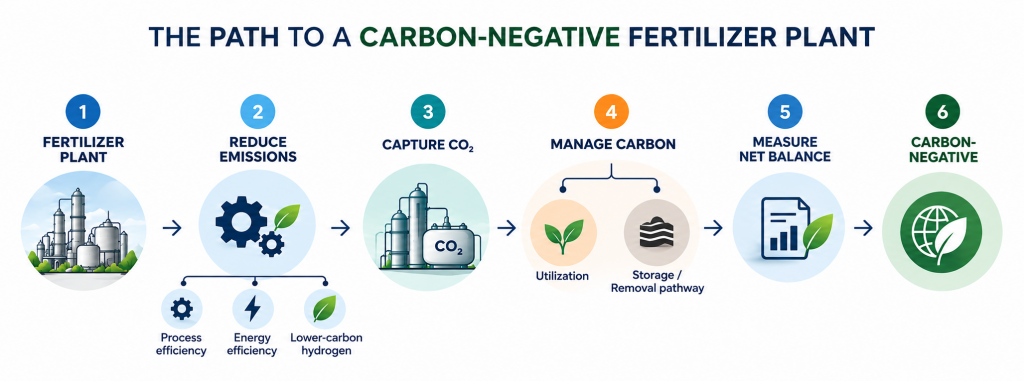
First, reduce. Lower process and energy-related emissions wherever technically and economically feasible.
Then, capture. Identify concentrated CO2 streams where concentration, pressure, availability, and continuity make recovery or capture practical.
Next, manage the carbon. Utilization, temporary use, permanent storage, and atmospheric removal have very different implications for the final balance.
Finally, prove the balance. Residual emissions, energy inputs, upstream impacts, system boundaries, and the permanence of carbon storage all have to be accounted for before a carbon-negative position can be credibly established.
The critical distinction is therefore simple: CO2 recovery manages a carbon stream; durable removal changes the atmospheric carbon balance. Recovery can form part of a broader carbon-negative strategy, but it cannot establish carbon negativity by itself.
Where does the carbon enter conventional ammonia production?
In conventional ammonia production, the principal carbon contribution originates in the hydrogen-generation stage, before synthesis begins. Natural gas is commonly used as the feedstock for steam methane reforming (SMR), where its carbon content is converted into CO2 as hydrogen is produced.
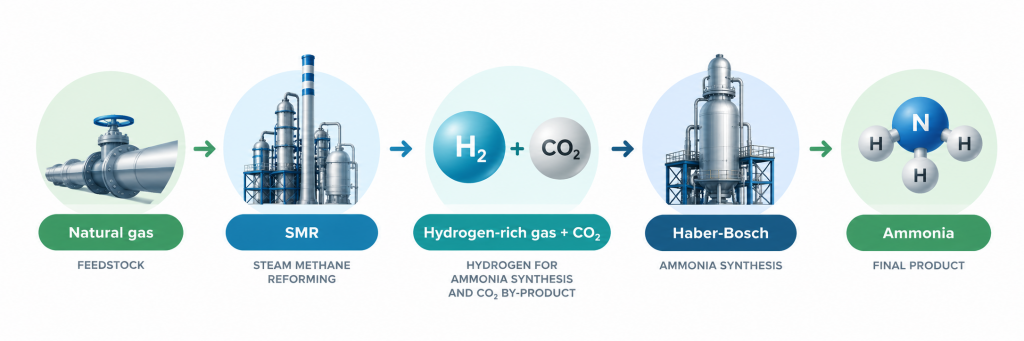
The resulting hydrogen-rich stream then enters the Haber-Bosch loop, where it reacts with nitrogen to form ammonia. This makes the hydrogen route an important determinant of the plant’s initial carbon intensity.
The route matters, but it is only the starting point
Changing the hydrogen pathway can materially alter the carbon profile of ammonia production. However, it does not by itself determine the carbon position of the fertilizer facility. That depends on how the process configuration, energy system, emissions profile, and carbon streams function together.
For an existing facility, the scope for improvement is shaped by the plant’s installed configuration, utility network, equipment interfaces, and production continuity requirements. A greenfield project, by contrast, can incorporate carbon considerations earlier, allowing process, energy, and CO2-handling infrastructure to be configured around the intended operating and carbon objectives.
Assessing the plant as a carbon system
A meaningful carbon assessment therefore needs to examine the plant beyond its headline production route:
Carbon sources
Establish the material contributors across process operations, fuel use, energy consumption, and relevant upstream activities.
Avoidable emissions
Identify where process improvements, efficiency measures, electrification, or lower-carbon energy can reduce the load before carbon capture is considered.
Recoverable CO2
Evaluate individual streams on their technical characteristics, particularly concentration, pressure, quality, continuity, and availability. Their recovery potential is not uniform.
Carbon disposition
The eventual treatment of captured CO2 becomes a separate consideration. Utilization, temporary retention, durable storage, and atmospheric removal have materially different implications for the overall carbon balance.
This is the point at which the analysis moves from how ammonia is produced to how the entire fertilizer plant manages its carbon flows.
What would a carbon-negative fertilizer plant look like?
Greenfield and existing plants follow different paths
A carbon-negative architecture will not look identical across fertilizer facilities. A greenfield project can establish its process configuration, energy system, and CO2 infrastructure around its intended carbon performance from the outset.
An existing plant has to work within an installed process, interconnected utilities, available space, production schedules, and equipment limitations.
| Consideration | Greenfield plant | Existing plant |
|---|---|---|
|
Process design |
Can be configured around lower-carbon production |
Must work around existing process configuration |
|
Energy system |
Low-carbon energy can be integrated at design stage |
Existing utilities may constrain optimization |
|
CO2 infrastructure |
Capture, conditioning, transport, and storage can be planned as an integrated system |
Retrofitting may require complex process integration |
|
Capital approach |
Greater influence at the initial design stage |
Investment is typically phased around priorities |
|
Production continuity |
Carbon architecture is established before operation |
Modifications must accommodate ongoing production |
|
Primary focus |
Optimize the complete system |
Identify the highest-value retrofit opportunities |
The engineering priorities therefore change with the project stage. For a new facility, carbon performance can influence major decisions before equipment and utilities are committed.
For an operating plant, the more practical question is where targeted modifications can deliver meaningful improvement without compromising production or creating disproportionate capital and integration demands.
That makes the pathway less about pursuing a universal technology stack and more about matching carbon interventions to the plant’s physical configuration, operating constraints, available CO2 streams, energy profile, and investment horizon.
A carbon-negative claim needs more than a technology
A credible carbon-negative position begins with a defined carbon-accounting framework. The result depends not only on what happens within the plant boundary, but also on which upstream and downstream emissions are included in the assessment.
Energy and natural gas inputs, hydrogen production, transportation, and other relevant value-chain contributions can materially influence the final balance.
Permanence is equally important. CO2 that is captured temporarily, or incorporated into a product from which it is subsequently released, has a fundamentally different carbon-accounting significance from carbon directed to a pathway designed for durable storage or removal.
The meaningful metric, therefore, is not the volume of CO2 captured, but the net greenhouse gas removal demonstrated after all relevant emissions and carbon flows are accounted for.
Recovery manages carbon. Removal changes the balance
CO2 recovery can play an important role in improving the carbon performance of an ammonia or fertilizer plant, particularly where a concentrated process stream can be recovered and put to productive use. It can reduce avoidable release while creating an economic value stream from a process by-product.
Its contribution to carbon negativity, however, depends on the ultimate fate of that carbon. CO2 that is recovered and subsequently released returns to the atmospheric carbon cycle; it does not constitute permanent removal. By contrast, a pathway designed for durable storage or atmospheric removal can contribute directly to reducing the net carbon balance.
Recovery is therefore a carbon-management measure, not a standalone pathway to carbon negativity. Its greatest value emerges when integrated with broader emission-reduction and durable-removal strategies.
What does Hypro contribute to this carbon-management architecture?
For a suitable concentrated CO2 stream, recovery can turn an unavoidable process output into a controlled, specification-grade product stream. Hypro CO2 Recovery Plant is engineered for precisely this intervention, integrating CO2 purification, liquefaction, and automated plant management within a single recovery system.
The plant recovers CO2 at a guaranteed purity of 99.998% v/v, with food-grade odor treatment to support product quality. An operating pressure of 16-18 bar g is selected for efficient system operation, while PLC-based automation and remote access enable continuous monitoring and plant management with reduced dependence on manual intervention.
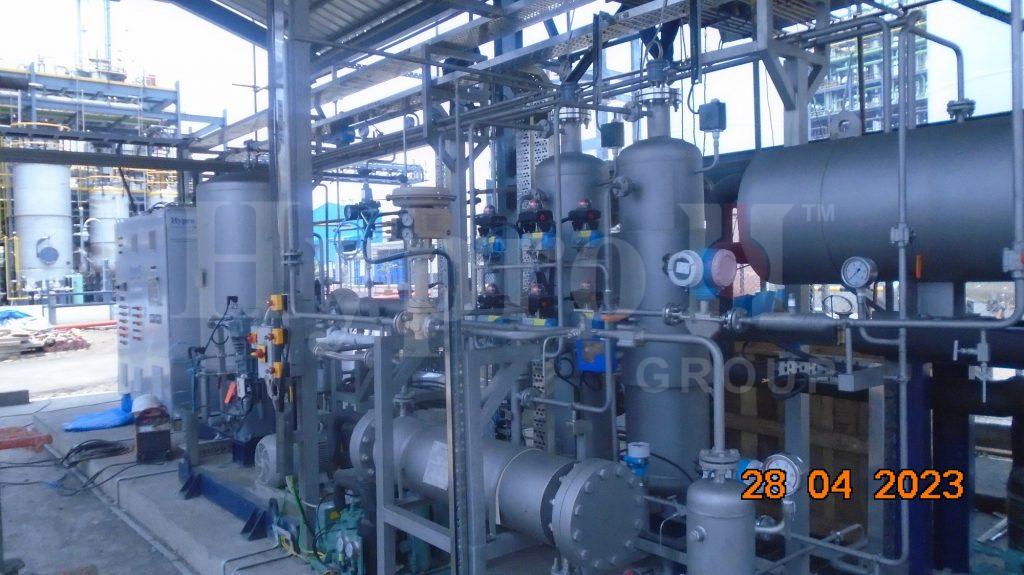
More importantly, Hypro positions CO2 recovery as a practical plant-level intervention: capturing a suitable process stream, conditioning it for productive use, and extracting value from carbon that would otherwise leave the process as a waste stream.
Hypro technology reflects a larger shift in industrial engineering, where carbon is no longer viewed solely as an emission to be controlled, but as a valuable process resource that can be recovered, put to productive use, and converted into an additional revenue stream.
So, can a fertilizer plant go carbon-negative?
Perhaps the more important shift is in how the industry defines progress. Carbon performance is moving from a measure of emissions intensity toward a broader assessment of how a fertilizer plant produces, handles, and accounts for carbon across its operating life.
That places greater significance on decisions made well beyond the core synthesis process. Plant architecture, utility integration, CO2 infrastructure, retrofit strategy, and long-term carbon management increasingly become interconnected considerations rather than isolated engineering choices.
For a new facility, this perspective can be incorporated into the plant concept before major systems are committed. For an operating facility, the same objective calls for a more selective approach, where technical feasibility, production continuity, infrastructure, and investment priorities determine the sequence of interventions.
Ultimately, the transition toward carbon-negative fertilizer production is less about finding a defining technology and more about reframing the plant itself as a carbon system.
The measure of progress, therefore, is not simply how much carbon a fertilizer plant can avoid, capture, or recover. It is whether the resulting carbon position can be measured, substantiated, and sustained over the life of the facility.
Related Posts

CO2 recovery from amine production and specialty chemicals
Recovering CO2 from amine and specialty chemical production transforms what was once a liability into a valuable, high-purity resource for food, pharma, and fuel applications....
Read More
CO2 Recovery from Chemical Industry: The Hidden Catalyst Driving Sustainability
Hypro is transforming CO2 recovery in the chemical industry with innovative, energy-efficient solutions. Discover how Alkyl Amines Chemicals cut emissions, overcame challenges, and turned waste...
Read More
Engineering Sustainability: Every Day is Earth Day at Hypro
Hypro believes Earth Day is more than a moment - it’s a mission. From sustainability-driven innovations to CO2 recovery and digital transformation, discover how Hypro...
Read More