#CO2 #Spirits #water #Sustainability
Water Management in Distilleries: Recovery and Reuse
Water enters a distillery long before the first drop of spirit reaches the bottle. It is used across fermentation, distillation, cooling, steam generation, cleaning, dilution, and blending, but it does not leave the plant as one uniform wastewater stream. Each application creates water with different temperatures, dissolved solids, chemical loads, and contamination levels.
Where Is Water Used in a Distillery?
| Distillery area | Key water streams |
|---|---|
|
Fermentation |
Process water, dilution water, vessel cleaning |
|
Distillation |
Condenser cooling, equipment cleaning, process water |
|
Boiler house |
Makeup water, condensate, blowdown |
|
Cooling systems |
Circulating water, makeup, blowdown |
|
CIP |
Pre-rinse, chemical wash, intermediate and final rinse |
|
Spirit handling |
Dilution and blending water |
|
Wastewater treatment |
Influent, treated water and discharge |
Fermentation and Process Water
Water is used to prepare mash, dilute molasses or other feedstocks where required, and establish the conditions needed for fermentation. Its quality can influence fermentation performance, so parameters such as pH, hardness, and mineral composition must suit the process and feedstock.
Distillation
Boilers and Steam Generation
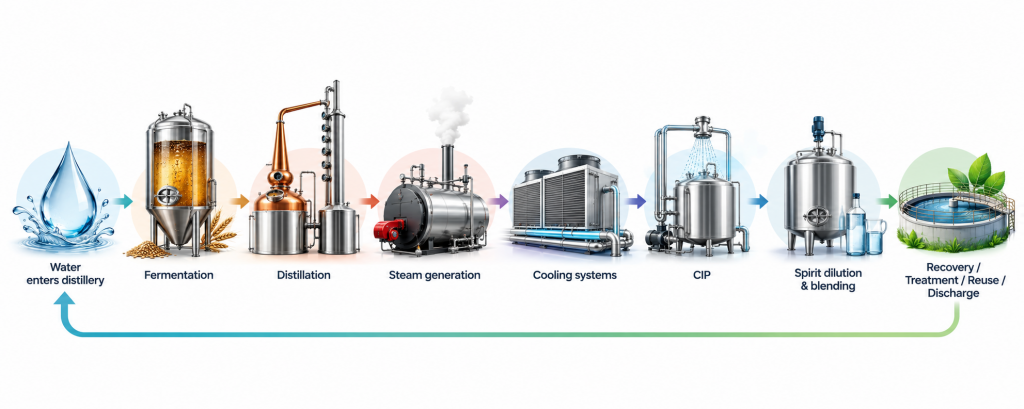
Cooling Systems
Cooling water removes heat from condensers, heat exchangers, and other process equipment. In recirculating systems, water losses occur through evaporation, drift, and blowdown. These losses determine the makeup water required to maintain cooling performance.
CIP and Equipment Cleaning
Cleaning-in-place (CIP) operations use water for pre-rinsing, chemical cleaning, intermediate rinsing, and final rinsing of tanks, pipelines, and process equipment. Water demand varies with the cleaning sequence, equipment design, product residues, and required hygiene standards.
Spirit Dilution and Blending
Water is added to reduce the alcohol concentration of the spirit to the required bottling strength and may also be used during blending. Because this water becomes part of the finished product, its chemical and microbiological quality must meet the distillery’s specifications
Identifying Water Recovery Opportunities in Distilleries
Once water use across the plant is understood, the next step is to identify streams that can be recovered, recirculated, or reused. Effective water recovery in distilleries depends on stream quality, temperature, contamination risk, treatment requirements, and the availability of a suitable reuse application.
Start With a Distillery Water Balance
Map water inputs and outputs across major process areas, including fermentation, distillation, boilers, cooling systems, and cleaning operations. Record freshwater intake, internal transfers, wastewater generation, and existing reuse. This helps quantify distillery water consumption, locate avoidable losses, and identify streams with potential for recovery and reuse.
Condensate From Steam Systems
Steam condensate may retain useful heat and, if its quality is suitable, can be returned to the boiler feedwater system. Recovering clean condensate can reduce both freshwater demand and the energy required to heat replacement water. Before return, assess the risk of contamination from process leaks or equipment failure.
Cooling Water Recirculation
Existing recirculating systems may offer further scope to optimize cycles of concentration and reduce blowdown, provided scaling, corrosion, and biological growth remain controlled. Blowdown should only be considered for reuse after its quality and treatment needs have been evaluated.
Recovery Within CIP Operations
Segregated rinse streams may offer reuse potential, particularly where they have lower chemical or product-residue loads. For example, a suitable earlier rinse may be evaluated for use in a subsequent pre-rinse stage. Reuse must be validated against cleaning effectiveness, hygiene requirements, and the risk of transferring residues between product streams.
Treated Water for Secondary Applications
Why Total Water Consumption Does Not Tell the Whole Story
Why Water Recovery Is Not as Simple as Reusing Wastewater
Recovering water is only one part of the equation. The more important question is whether the recovered stream has the right quality for its next use.
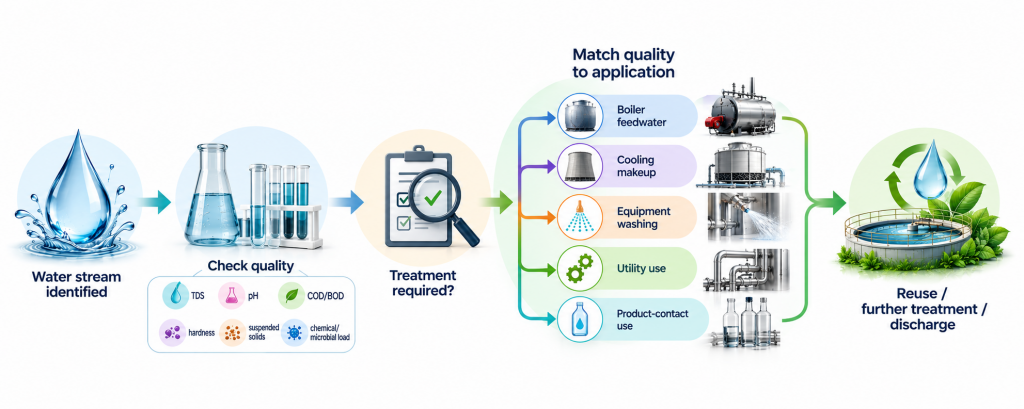
Key parameters may include:
- TDS and conductivity
- pH
- COD and BOD
- Hardness
- Suspended solids
- Chemical residues
- Microbiological load
- Temperature
Treatment Should Follow the Intended Use
For example:
| Water stream | Treatment considerations | Potential reuse |
|---|---|---|
|
Steam condensate |
Filtration, polishing, or demineralization |
Boiler feedwater |
|
Cooling-tower blowdown |
Filtration, softening, or membrane treatment |
Cooling makeup |
|
CIP rinse water |
Filtration, pH adjustment, further treatment as required |
Cleaning or utility use |
|
Treated distillery effluent |
Tertiary filtration, disinfection, membrane treatment |
Cooling or equipment washing |
|
Process condensate |
Filtration, polishing, quality-specific treatment |
Utility or process use |
|
High-TDS streams |
Membrane or other TDS-specific treatment |
Selected utility applications |
*Actual treatment requirements depend on laboratory analysis, process configuration, and the quality specification of the receiving application.
This is why water reuse in distilleries is better approached as a fit-for-purpose exercise than as a blanket recycling target. Water intended for boiler makeup, cooling, equipment washing, or product contact will each have different quality requirements.
Protecting Spirit Quality During Water Reuse
This distinction is important when designing a reuse strategy. Water that is suitable for cooling makeup or equipment washing cannot automatically be considered suitable for spirit dilution. Product-contact applications require a separate quality assessment and appropriate treatment before recovered water can be considered for use.
Building a Water Management Strategy for a Distillery
Establish a baseline
Prioritize practical recovery opportunities
Validate reuse feasibility
Pilot before scaling up
Verify the results
This helps distilleries prioritize recovery opportunities according to technical feasibility and operational value, rather than selecting treatment technology before the need is established.
Beyond Water Circularity: Recovering CO2 from Distillery Fermentation
With nearly three decades of experience and deep expertise in carbon management, Hypro is an industry leader in CO2 recovery solutions for process industries.

Hypro brings the process know-how and recovery technology to help make that carbon circularity opportunity achievable.
What Should Distilleries Measure?
| Metrics | What to track |
|---|---|
|
Water intensity |
Freshwater used per L or KL of spirit produced |
|
Process-wise water use |
Consumption across fermentation, distillation, CIP, cooling, and utilities |
|
Water recovery and reuse |
Volume of water recovered and reused within the plant |
|
Wastewater generation |
Effluent volume per L or KL of spirit produced |
In a nutshell
Related Posts

Biogas Production from Distillery: Spent Wash & Energy Management
Biogas production from distillery spent wash turns waste into energy, reducing costs and emissions while...
Read More
Engineering Sustainability: Every Day is Earth Day at Hypro
Hypro believes Earth Day is more than a moment - it’s a mission. From sustainability-driven...
Read More
Environment first: A resilient circular carbon journey led by Hypro
On the World Environment Day, Hypro redefines the role of industry - not as a...
Read More