#Hops #CO2 #beer #Sustainability
How Modern Hop Processing Maximizes Extraction Efficiency and Eliminates Batch Variability
Achieving absolute product consistency across multiple facilities is a major challenge for modern commercial breweries. To secure this repeatability, production teams must manage the natural chemistry of their raw ingredients, making efficient hop processing a critical operational necessity.
Hops represent the most chemically volatile botanical input in the brewhouse. Natural fluctuations in bittering alpha acids and delicate essential oils occur constantly due to year-to-year shifts in weather and regional soil conditions.

Unmanaged agricultural variations introduce severe batch to batch inconsistencies. This unpredictability compromises target brewhouse yields, recipe predictability, and overall brand integrity.
Industrial distribution networks demand strict adherence to contract product specifications. To stabilize the supply chain, modern hop processing transforms highly perishable agricultural yields into stable, standardized, and concentrated formats.
This systematic manipulation does more than safeguard sensory profiles. It fundamentally optimizes the physical chemistry of compound extraction.
Understanding how hop processing alters botanical matrix structures allows hop suppliers and macro producers to maximize raw material utilization. This approach eliminates waste, slashes global transit footprints, and establishes an operationally efficient manufacturing pipeline.
Post-harvest biochemical degradation and stabilization
The degradation of raw hop cones begins the moment they are severed from the bine. As live agricultural tissue, harvested hops undergo rapid post-harvest respiration, generating ambient heat within bulk storage bins.
This thermal tracking accelerates the metabolic breakdown of volatile organic compounds. Left unchecked, the delicate chemical architecture required for brewing consistency deteriorates within hours.
The primary vectors of degradation are ambient oxidation and thermal volatilization. Essential mono-terpenes, specifically myrcene, exhibit low boiling points and evaporate rapidly under standard atmospheric exposure.
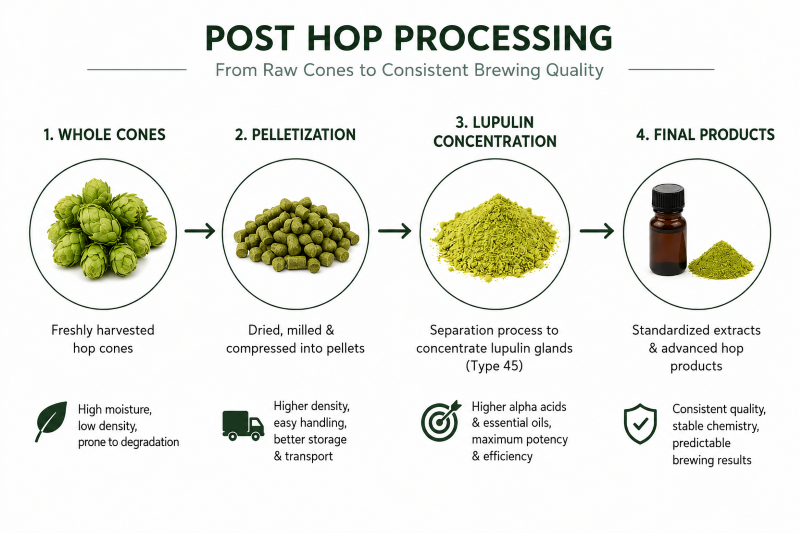
Simultaneously, atmospheric oxygen triggers the auto-oxidation of soft resins. This reaction transforms bittering humulones into oxidized beta compounds, permanently altering the target bittering potential of the crop.
To arrest this biochemical decay, immediate post-harvest hop processing is mandatory. Standard farm level kilning reduces moisture content from 75% down to roughly 9%, stabilizing the organic material for transport.
However, simple drying does not permanently preserve the volatile oil fraction. Advanced hop processing methodologies utilize strict temperature controls and inert gas blanketing to halt the oxidation cascade completely.
By executing a precise thermal arrest, industrial processors lock the plant chemistry into a stable state. This initial phase of hop processing ensures that the raw materials arrive at downstream facilities with their alpha acid percentages and essential oil profiles perfectly intact.
Mechanical pelletization: Density, friction, and thermal control
The physical transformation of stabilized whole cones into pelletized formats marks the first true industrial milestone in modern hop processing. While whole cones carry traditional appeal, their low bulk density creates immense logistical headaches for global suppliers and operational inefficiencies for large breweries.
Compacting this loose material into highly uniform, dense cylinders fundamentally rewires both global transit economics and brewhouse extraction kinetics. When raw hops are compressed, the process significantly reduces cold-storage volume constraints and shipping overhead by up to 80%.
Beyond simple freight advantages, fracturing the physical cell walls of the hop cone permanently alters its brewing performance. Mechanical milling shears the structural tissue of the plant, exposing the internal lupulin glands.
When these pellets hit hot wort in the brewhouse, the vastly increased surface area accelerates mass transfer rates, driving up overall extraction efficiency.
Optimizing the lupulin concentration matrix
Industrial pelletization typically follows one of two specialized manufacturing pathways depending on the target product requirement. The standard approach yields Type 90 pellets, where raw hop cones are swept of field debris, dried, ground into powder, and extruded. This format preserves roughly 90% of the original vegetative bulk, making it a reliable workhorse for early kettle bittering and standard whirlpool additions.
To unlock maximum efficiency, advanced hop processing facilities pivot to the highly engineered Type 45 pathway. This mechanical process strips away non-functional cellulosic vegetative matter, such as inert leaves and stems, at sub-zero temperatures. By discarding this unhelpful bulk, processors concentrate the pure lupulin glands, effectively doubling the alpha-acid percentage per unit of mass.
Type 90 Pellets: Maintain a bulk density of 450 to 500 kg/m³ while retaining the vast majority of the original vegetative skeleton.
Type 45 Pellets: Achieve a highly concentrated density of 550 to 600 kg/m³ by mechanically removing non-functional material during sub-zero sifting.
Controlling the thermodynamics of milling
Shifting from bulky agricultural cones to uniform powders requires high-intensity mechanical shearing, which introduces severe thermodynamic risks to the hop’s delicate chemical architecture. Industrial hammer mills and extrusion dies generate massive kinetic friction and heat during continuous operation. This heat is the silent killer of volatile essential oils.
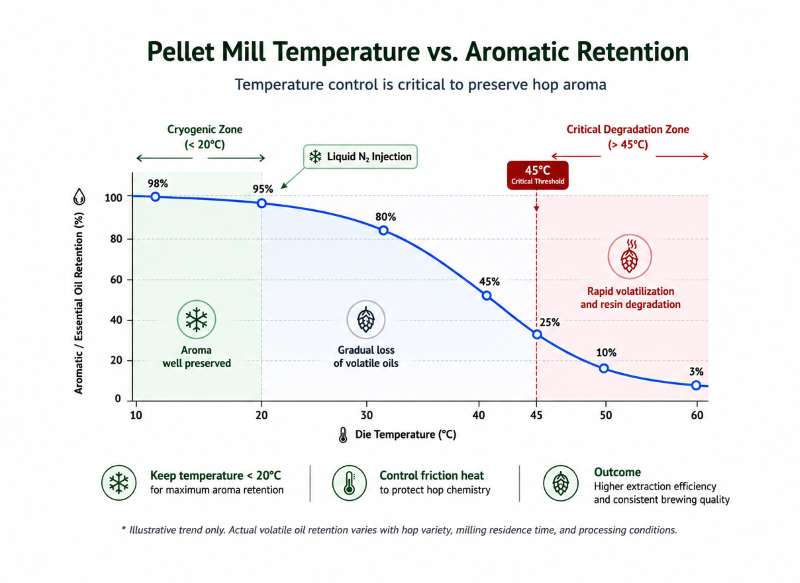
If internal processing temperatures breach a critical 45°C threshold, volatile essential mono-terpenes flash off into the facility atmosphere and are lost forever. Simultaneously, soft resins undergo premature thermal degradation, skewing the precise bittering potential of the crop. This variance destroys the exact batch uniformity that commercial breweries depend on for their flagship brands.
To eliminate this threat, modern hop processing plants jacket their milling loops in automated cryogenic chilling systems. Injecting liquid nitrogen directly into the milling chamber maintains processing thresholds safely below 20°C. This thermal management locks sensitive, aromatic hydrocarbons deeply into the physical matrix of the finished pellet, ensuring they survive until they reach the brewhouse.
Balancing durability against brewhouse trub loss
The final stage of pelletized hop processing requires a strict operational compromise between physical durability and rapid solubility. If compression forces within the pellet press are dialed too high, the resulting product becomes overly dense.
These hard pellets fail to disintegrate evenly when dropped into hot wort, causing unpredictable extraction curves and leaving valuable alpha acids trapped in the sludge.
Conversely, under-compressed pellets lack structural integrity and break down prematurely into fine dust during transport and storage. When introduced to the brewery whirlpool, these microscopic vegetative particles fail to settle into a tight, clean cone.
The resulting loose sludge creates massive trub loss, trapping hundreds of liters of valuable beer inside wet spent solids and eroding the brewery’s liquid yield margins.
Mastering this physical equilibrium allows top-tier processors to deliver a standardized format that optimizes downstream brewery logistics. It ensures that the product survives global supply chains intact while remaining perfectly engineered for rapid, predictable extraction in the brewhouse.
Supercritical CO2 extraction: The ultimate tool for batch homogenization
The transition from physical compression to chemical separation represents the highest technological tier of modern hop processing. While advanced pelletization provides significant storage advantages, physical formats still retain a massive volume of structural cellulose.
This vegetative skeleton introduces a major variable into the brewhouse, absorbing valuable liquid in the whirlpool and introducing natural sensory variations based on seasonal harvest lots.
To establish absolute batch consistency, modern industrial plants decouple the active bittering and aromatic components from the plant skeleton entirely. Processors choose industrial supercritical carbon dioxide extraction to execute this flawless molecular separation.
By shifting carbon dioxide gas past its critical thermodynamic threshold, the solvent loop isolates pure resin fractions while leaving heavy polyphenols, water-soluble proteins, and crude lipids behind.
The thermodynamics of phase-change solvent loops
This highly advanced method of hop processing relies on precise pressure and temperature configurations. Industrial operators compress carbon dioxide gas beyond 73.9 bar and raise temperatures above 31.1°C inside heavy extraction vessels. At this exact coordinate, the gas enters a supercritical phase, displaying the dense solvating power of a liquid alongside rapid mass-transfer diffusivity of a gas.
| Target Botanical Fraction | Solubility Precision Phase | Primary Industrial Function |
|---|---|---|
|
Alpha Resins |
High pressure selective extraction |
Yields a completely clean bittering foundation |
|
Beta Resins |
Fractionated temperature tuning |
Maximizes long term storage stability for supply chains |
|
Essential Oils |
Low temperature gas sweep |
Preserves delicate aroma hydrocarbons from oxygen |
This unique state allows the fluid to penetrate deep into the botanical matrix, effortlessly dissolving target fractions hidden within the lupulin structure. By carefully adjusting pressure and temperature variables, specialized hop processing extraction loops selectively pull these vital brewing elements. This chemical tuning yields a gold-standard concentrate completely free from vegetative bulk.
Driving supply-chain homogenization
The primary value of this phase of hop processing for global suppliers rests in its ability to standardize heterogeneous agricultural yields. Natural field harvests present massive contract fulfillment risks when alpha-acid percentages swing wildly between different regional lots.
Advanced extraction loops eliminate this problem by dissolving disparate lots and blending the isolated resins into perfectly uniform, standardized batches.
This meticulous stabilization process guarantees a fixed, predictable alpha-acid mass percentage per container, protecting commercial contract boundaries. Suppliers can fulfill multi-year macro brewery agreements with absolute technical precision while completely eliminating agricultural raw crop volatility.
Furthermore, removing the bulky plant skeleton yields massive logistics dividends, producing a concentrated, pourable resin that delivers exceptional shelf stability.
This liquid evolution represents a massive leap forward in hop processing efficiency, yielding a stable chemical state for long-term storage. It guarantees absolute recipe predictability for the commercial producer while optimizing operational costs across the entire supply chain.
Volume Reduction: Achieves up to an 85% mass reduction over compact pellets, drastically lowering global shipping overhead.
Storage Preservation: Eliminates the strict requirement for costly sub-zero storage infrastructure, slashing facility utility costs.
Oxidation Defense: Provides zero oxygen exposure inside hermetically sealed canisters, indefinitely locking in the hop’s pure resin profile.
The closed-loop processing facility: Integrating advanced utility recovery
While supercritical extraction stands as the undisputed standard for batch homogenization, operating high-pressure solvent loops introduces severe facility-level utility constraints. Processing large agricultural volumes requires an immense, continuous inventory of carbon dioxide gas.
In standard non-recovery configurations, venting this gas at the conclusion of an extraction cycle is highly problematic. This exhaust approach generates high recurring procurement costs, expands the facility’s carbon footprint, and introduces heavy supply-chain vulnerabilities.
To optimize plant economics without altering product quality, advanced hop processing plants are shifting toward integrated, closed-loop recovery technology. As an industry pioneer, Hypro engineered the sector’s first specialized solution by deploying a custom 700 kg/hr capacity Supercritical CO2 Recovery Plant for Yakima Chief Hops.
These automated systems capture, compress, and purify up to 95% of the process gas directly from the extraction separators, permanently lowering external procurement dependency.

Overcoming the contamination and energy bottlenecks
Traditional gas recovery systems often fail in extraction environments due to the presence of carryover particulates. High-pressure loops naturally aerosolize microscopic hop dust and sticky alpha resins, which rapidly foul standard compressor valves and cause premature mechanical failure.
| Engineering Bottleneck | Conventional System Failure | Hypro Closed-Loop Solution |
|---|---|---|
|
Resin & Dust Fouling |
Clogs compressor valves, leading to contamination and downtime |
Scrubbers isolate oils and hop dust to protect downstream hardware |
|
High Compression Cost |
Demands massive electrical input to compress gas from a dead stop |
Low-pressure process (< 260 psi) eliminates 40% of compression energy |
|
Atmospheric Emissions |
Vents hundreds of kilograms of carbon gas per cycle into the air |
Cuts localized gas emissions by more than 80% via constant reuse |
This closed-loop integration provides significant thermodynamics advantages. Operating at a low-pressure threshold under 260 psi allows the plant to process nearly 40% of the carbon dioxide gas without demanding any raw compression or pumping energy.
The system effectively flattens operational demand peaks during heavy production periods, allowing suppliers to scale up their hop processing throughput while achieving over an 80% reduction in atmospheric gas venting.
Furthermore, maintaining chemical purity is a non-negotiable requirement for suppliers running diverse single-varietal extract lines. The multi-stage purification track guarantees a final gas purity exceeding 99.997% v/v, preventing cross-contamination between successive batches of distinct aromatic cultivars.
This precise engineering by Hypro ensures that global processors can achieve aggressive corporate ESG sustainability goals while directly insulating their internal operating margins.
The supply-chain dividend: Mutual payoffs for suppliers and producers
The implementation of advanced hop processing mechanisms delivers significant operational dividends that benefit both sides of the commercial brewing supply chain. By shifting away from raw, perishable agricultural commodities and embracing highly stable, standardized formats, the entire distribution network achieves greater financial and technical predictability.
Technological evolution transforms a volatile agricultural crop into a highly uniform industrial asset, protecting profit margins from the farm all the way to the finished pint.
For the industrial hop supplier, the advantages of advanced hop processing are deeply tied to storage economics and inventory management. Concentrated pellets and supercritical extracts drastically reduce warehousing footprints, allowing facilities to maximize cold storage utility while lowering logistics overheads.
Furthermore, the extreme shelf stability of processed formats eliminates the time-sensitive pressure of post-harvest crop degradation, granting suppliers the flexibility to fulfill multi-year macro brewery contracts with fixed product specifications.
Quantifying the operational brewhouse dividend
For the commercial beer producer, utilizing advanced hop processing formats solves the constant battle against batch-to-batch brewing variability. Traditional whole cones absorb immense amounts of liquid during the boil, but processed extracts and concentrated pellets pass cleanly through the brewhouse without leaving heavy vegetative sludge behind.
This physical optimization alters the underlying financial metrics of daily brewing operations, driving noticeable increases in liquid cellar yields.
By eliminating the bulky plant skeleton from the hot side, production facilities can expect precise, predictable international bitterness unit calculations and completely stable aroma extraction curves.
This reliability allows large scale macro and regional breweries to scale up their production volume without risking the core brand identity of their flagship product lines. Ultimately, this high utilization approach creates a highly efficient manufacturing loop where zero raw material mass is wasted.
Suppliers: Gain indefinite product shelf stability, lowered global shipping mass, and reduced warehouse utility overhead.
Brewers: Achieve exact recipe repeatability, predictable bittering curves, and near-zero whirlpool trub loss.
Ultimately, the transition from raw agricultural volatility to precise engineering is the future of the global brewing industry. Standardizing hop processing mechanisms does more than just protect the sensory identity of a flagship beer brand. It builds a highly efficient, predictable, and sustainable supply chain that safeguards the operational margins of hop suppliers and commercial producers alike.
Related Posts

CO2 Recovery Myths Debunked by Hypro for Small-Scale Brewing Operations
Hypro's technology proves that craft breweries can achieve the same quality, efficiency, and operational benefits as large industrial breweries, debunking the myth that CO2 recovery...
Read More
Key Market Trends in Hops Processing Shaping the Future of Brewing
Explore the latest trends in hops processing, including sustainability, specialty hops, advanced technologies, and global market opportunities.
Read More
Industrial Brewery in Greenfield Setup – Turnkey & Sustainable
From bare land to brewing legacy; setting up an industrial brewery is more than installation. Hypro’s turnkey approach blends deep engineering with brewmaster intuition. Discover...
Read More