#naturalgas #PowerPlant #CO2 #sustainability #carbonfootprint

CO2 emissions from natural gas power plants: From capture to recovery

CO2 emissions from natural gas power plants present an opportunity that often goes overlooked. Although natural gas is widely regarded as a lower-carbon alternative to coal, its combustion still releases substantial quantities of CO2 into the atmosphere.

For power plants operating at scale, these emissions represent more than an environmental challenge. They also raise an important question: Can the CO2 being discharged through turbine exhaust streams be captured and recovered for productive use?

CO2 emissions from natural gas power plants
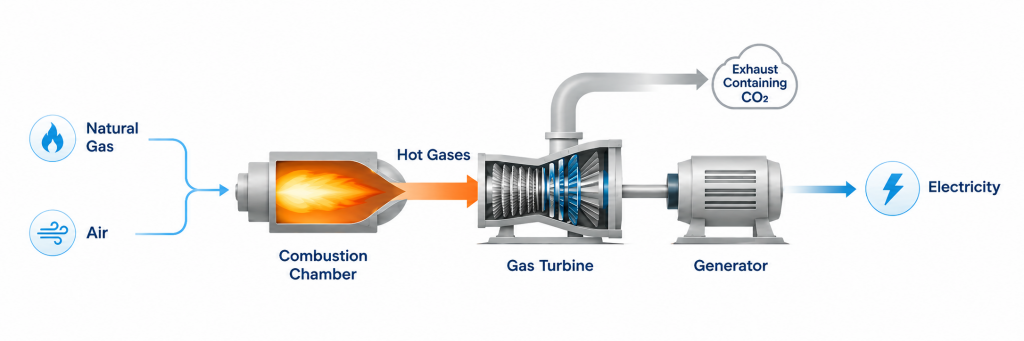
The answer, however, involves more than simply separating CO2 from exhaust gases. Relatively low CO2 concentrations, large flue gas volumes, and varying gas compositions make capture and downstream processing technically demanding.
Understanding these challenges is essential to evaluating the potential for CO2 recovery in natural gas power plants, from selecting suitable capture technologies to processing the separated gas into a usable industrial resource.

CO2 emissions from natural gas power plants

Natural gas consists primarily of methane (CH4), a hydrocarbon that releases energy when it reacts with oxygen during combustion. This reaction produces carbon dioxide and water vapor: CH4 + 2O2 → CO2 + 2H2O + Heat
how CO2 emissions are generated from natural gas power plants
The amount of CO2 released depends primarily on natural gas consumption, while emissions per unit of electricity are influenced by the plant’s heat rate.
A higher heat rate indicates that more fuel energy is required to generate the same electrical output, generally resulting in higher CO2 emissions per unit of electricity. Gas turbine technology, operating load, and fuel composition also influence the overall emissions profile.

According to the US Energy Information Administration (EIA), the direct combustion emission factor for natural gas is approximately 52.91 kg of CO2 per million Btu of fuel input. This US reference factor provides a useful basis for estimating emissions from natural gas consumption. Actual emissions per unit of electricity, however, depend on the plant’s heat rate and fuel consumption.

Where does CO2 concentrate in a natural gas power plant?

In gas turbine-based power generation, CO2 produced during combustion exits as part of the turbine exhaust, or flue gas. This stream also contains nitrogen, oxygen, and water vapor, meaning that CO2 is mixed with other combustion products rather than discharged separately.
In a simple-cycle gas turbine plant, the exhaust is discharged after passing through the turbine. In a combined-cycle configuration, it first passes through a heat recovery steam generator (HRSG), where heat from the exhaust is used to generate steam for additional electricity production. The remaining flue gas is then discharged through the exhaust stack.
For CO2 recovery, the exhaust downstream of the turbine, or the HRSG in a combined-cycle plant, represents the primary point of interest for post-combustion capture.

Typical flue gas composition of an NGCC power plant

The following table illustrates the representative composition of exhaust gas from a Natural Gas Combined Cycle (NGCC) power plant according to the National Petroleum Council.
Gas constituent Approx. concentration (mol %)
Nitrogen (N2)
~75%
Carbon dioxide (CO2)
3-4%
Water vapor (H2O)
8-10%
Oxygen (O2)
12-15%
Argon (Ar)
~1%
SOx, NOx, and other constituents
Trace to less than 1%

Why does this composition matter for CO2 recovery?

The composition and flow rate of turbine exhaust are key parameters in evaluating CO2 capture requirements. Three factors are particularly relevant:
  • CO2 concentration: Determines the proportion of CO2 in the exhaust stream and influences the separation requirements.
  • Exhaust gas flow rate: Establishes the volume of gas the capture system must process to recover the available CO2.
  • Moisture content: Influences gas conditioning requirements and the selection of suitable capture processes.

Together, these parameters provide the basis for assessing capture system capacity, process requirements, and potential CO2 recovery.

Why is CO2 capture from natural gas power plants technically challenging?

Capturing CO2 from natural gas power plant exhaust involves several interconnected engineering challenges that influence separation performance, equipment sizing, energy consumption, and project economics.

Low CO2 partial pressure

With CO2 typically accounting for only 3-4% of NGCC flue gas, its partial pressure remains relatively low. In solvent-based absorption, this reduces the driving force for mass transfer from the gas phase into the solvent, making separation more demanding. Achieving the required capture rate consequently depends on appropriate solvent selection, operating conditions, and absorber design.

High flue gas volume

Natural gas turbines process substantial quantities of combustion air, resulting in large exhaust gas volumes relative to the amount of CO2 available for recovery. This creates several design implications:

  • Larger absorbers and gas handling equipment.
  • Higher pressure-drop and blower power requirements.
  • Greater equipment footprint and capital investment.

Oxygen-related solvent degradation

The relatively high oxygen content of turbine exhaust can accelerate oxidative degradation of aqueous amine solvents. This can lead to:
  • Solvent losses and increased replenishment requirements.
  • Formation of degradation byproducts.
  • Additional solvent management, maintenance, and operating costs.
Solvent formulation, oxygen exposure, and operating conditions therefore play important roles in maintaining capture system performance.

Energy requirements and plant integration

CO2 capture introduces additional thermal and electrical demands. In solvent-based systems, thermal energy is required to regenerate the solvent and release the captured CO2. Electricity is also consumed by pumps, blowers, and CO2 compressors.

These requirements have direct implications for power plant operations:

  • Steam extraction for solvent regeneration affects the steam cycle.
  • Auxiliary electricity consumption reduces the net power available for export.
  • Integration with existing steam, cooling, and electrical systems influences overall project feasibility.

This reduction in net power output is commonly referred to as the energy penalty of carbon capture.
Collectively, these constraints make the selection and integration of CO2 capture technology particularly important for natural gas power plants.

Engineering considerations for CO2 capture from natural gas power plants

The suitability of a CO2 capture technology depends not only on its separation capability but also on how effectively it performs under actual plant conditions. For natural gas power plants, two considerations are particularly important.

Technology maturity versus application suitability

Solvent-based absorption, solid sorbent adsorption, and membrane separation offer different approaches to post-combustion CO2 capture. However, their technical maturity does not necessarily translate into equal suitability for natural gas turbine exhaust.
The relatively low CO2 partial pressure, high oxygen content, and substantial exhaust gas throughput demand careful consideration of separation performance, material durability, and process configuration. Technology selection must therefore be based on application-specific performance rather than technological advancement alone.

Capture performance versus energy consumption

The quantity of CO2 captured is only one measure of system performance. The energy required to achieve that capture rate has a direct bearing on the overall economics of a power plant.
Solvent regeneration, gas circulation, cooling, and CO2 compression contribute to the system’s thermal and electrical demand. Consequently, capture efficiency must be evaluated alongside energy consumption, as excessive auxiliary requirements can reduce the net electricity available for export and affect operating economics.

From captured CO2 to a usable industrial resource

Capturing CO2 from natural gas power plant exhaust is only the first step. For the recovered gas to have industrial value, it must meet the quality and handling requirements of its intended application.

Captured CO2 is not necessarily recoverable CO2

The quantity of CO2 separated during capture does not automatically translate into the same quantity of usable product. The composition of the captured stream, its residual impurities, and the treatment required to meet the final specification all influence the amount that can ultimately be recovered.
This distinction is important when evaluating recovery potential. A high capture rate alone does not establish how much saleable or usable CO2 a plant can produce.

CO2 quality depends on its intended use

Different applications have different CO2 quality requirements. Food and beverage use, for example, demands compliance with relevant food-grade specifications. Other industrial applications may have different limits for purity and individual impurities.
The intended application must therefore guide the required product specification. Establishing this requirement early helps determine the extent of downstream processing and the associated investment and operating costs.

Assessing the feasibility of CO2 recovery in natural gas power plants

The growing interest in carbon capture at natural gas power plants reflects a broader engineering and commercial challenge: how to recover CO2 at a meaningful scale without compromising plant operations or creating an economically unsustainable system.
Projects at Polk Power Station in Florida and Genesee Generating Station in Alberta offer useful perspectives. Both involved evaluating post-combustion CO2 capture at large natural gas combined-cycle facilities. However, their development experiences highlight different aspects of project feasibility.
According to the US Department of Energy’s National Energy Technology Laboratory (NETL), the Polk project examined the engineering and cost requirements for retrofitting a commercial-scale capture system onto an existing 1,190 MW NGCC unit.
The proposed system targeted a capture capacity of nearly 3.7 million tonnes of CO2 annually, with the captured CO2 intended for onsite geological storage.
At Genesee, Capital Power’s FEED study established the technical viability of an amine-based capture system designed for approximately 95% CO2 capture, equivalent to around 3 million tonnes annually. However, in May 2024, the company discontinued further development, citing a lack of economic feasibility under the prevailing conditions.

These experiences point to several factors that determine whether a CO2 recovery project can progress beyond engineering assessment.

What determines project feasibility?

Integration with existing plant operations

A capture system must accommodate the plant’s operating conditions, steam and electricity requirements, available space, and operating flexibility. The resulting energy demand and modifications to existing infrastructure can significantly influence project costs and performance.

CO2 handling and destination

Capturing CO2 is only part of the requirement. The project must establish how the separated gas will be conditioned, transported, stored, or supplied to an end user. The availability and cost of the required infrastructure can materially affect feasibility.

Commercial viability

Capital investment, operating expenditure, energy costs, government incentives, and the potential value of recovered CO2 all influence the business case. As the Genesee project illustrates, technical viability alone does not guarantee that the investment will be commercially sustainable.
Ultimately, the feasibility of CO2 recovery depends on the combined strength of its engineering design, infrastructure requirements, and commercial proposition. Each must support the others for a project to advance towards implementation.

Hypro: Advancing CO2 capture, recovery and energy efficiency

The growing potential of CO2 recovery from natural gas power plants calls for technologies that address two important challenges: capturing CO2 from dilute combustion exhaust and making the recovery process more energy-efficient. Hypro, a leading manufacturer of industrial CO2 systems, is advancing both fronts through its expanding technology portfolio.

Extending CO2 recovery to flue gas capture

Traditionally, CO2 recovery systems process gas streams in which CO2 is already available at a suitable concentration. However, natural gas power plant exhaust presents a different challenge, as CO2 is mixed with large volumes of other combustion gases.
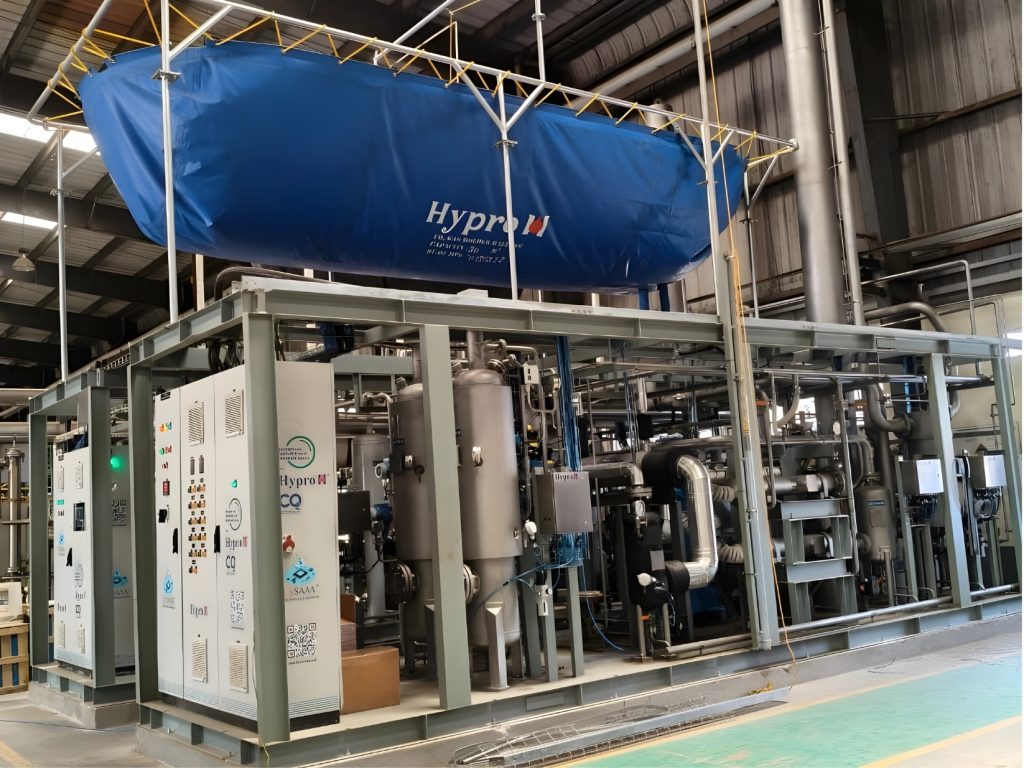
United Breweries, 500 kg CO2 Recovery System
Hypro has taken a significant step forward by developing an integrated flue gas CO2 capture and recovery solution. Its enrichment technology is designed to increase CO2 concentration in low-concentration combustion exhaust streams to more than 95%. The enriched stream can then undergo further processing through Hypro’s conventional CO2 recovery plant.
This development extends Hypro’s capabilities beyond conventional CO2 recovery, bringing the initial capture and subsequent recovery stages within its technology offering. For natural gas power plants, it opens up a new pathway to evaluate the recovery of CO2 that would otherwise leave the facility through exhaust streams.

Beyond CO2 recovery: Maximizing the value of energy

Hypro’s technological advancements extend beyond capturing and recovering CO2. The energy consumed in conventional CO2 production also presents an opportunity for improvement, particularly when a substantial portion of fuel energy is lost as exhaust heat.
To address this, Hypro has developed its Co-Co Gen and Quad-Gen systems, which utilize otherwise wasted exhaust heat to generate additional useful energy. The improvement in thermal efficiency is substantial when compared with the conventional CO2 production plant benchmark of 26.7%.
CO2 Production System Thermal Efficiency
Conventional Plant
26.7%
Hypro Co-Co Gen
80.6%
Hypro Quad-Gen
88.8%
These figures represent reported improvements of 201% for Co-Co Gen and 232% for Quad-Gen over the conventional plant benchmark.
The two systems offer distinct energy-generation capabilities. Co-Co Gen combines CO2 production with electricity and steam generation, while Quad-Gen extends this further by incorporating refrigeration and cooling energy. This allows multiple useful energy outputs to be generated from the same fuel source.
With fuel energy utilization of up to 88%, these systems offer the potential to reduce natural gas consumption for the same CO2 output while supplying useful energy to other plant operations.

A Broader vision for industrial CO2 technology

By advancing both flue gas CO2 capture and energy-efficient CO2 production, Hypro is expanding the possibilities of industrial CO2 technology. Its capabilities now extend beyond recovering an existing CO2 stream to addressing the challenges of capturing CO2 from combustion exhaust and extracting greater value from the energy used in its production.
For natural gas power plants and other energy-intensive industries, this represents a significant shift in how CO2 and energy resources can be managed. Hypro is bringing together process innovation and energy utilization to create greater value from industrial operations.

Industrial applications of recovered CO2

Recovered CO2 can serve as a valuable industrial input when processed to meet the quality requirements of its intended application. Its potential uses extend across several sectors:
  • Food and beverage: Used for beverage carbonation, food processing, packaging, and chilling applications, subject to relevant quality standards.
  • Chemical manufacturing: Used as a feedstock in urea production and, in combination with hydrogen, in methanol synthesis.
  • Greenhouse cultivation: Used to enrich greenhouse atmospheres and support plant growth under controlled conditions.
  • Industrial processes: Used in applications such as welding, metal fabrication, and certain manufacturing operations.
The commercial potential of recovered CO2 depends on local demand, product specifications, supply consistency, and the cost of processing and distribution. Identifying suitable end users is therefore an important part of establishing a viable CO2 recovery project.
The opportunity to recover CO2 emissions from natural gas power plants extends beyond conventional emission reduction strategies. It also presents an opportunity to rethink how power generation facilities interact with the wider industrial ecosystem.
As carbon capture technologies advance, power plants could become more than electricity producers. They could also emerge as potential suppliers of recovered CO2, creating new connections between the energy sector and industries that depend on a consistent supply of this resource.
Realizing this opportunity will require solutions that are engineered around the realities of each plant and supported by commercially viable applications. For technology providers, this creates an important direction for innovation: moving beyond conventional recovery systems towards integrated solutions capable of addressing the entire CO2 value chain.
The next phase of industrial CO2 recovery will belong to solutions that make capture technically practical and resource recovery commercially meaningful.

Related Posts


Share this article

Share on facebook
Facebook
Share on twitter
Twitter
Share on linkedin
LinkedIn
Share on whatsapp
WhatsApp
Share on email
Email